 Orvus
OrvusWhat is PageRank in SEO?
January 31, 2026
Quick answer: what PageRank means for modern SEO
Short definition: seo page rank
At its simplest, seo page rank refers to the original link analysis model that treats links as pathways for authority to flow across pages. The model describes propagation through the link graph using a damping factor, which makes the idea easy to reason about for practitioners learning link authority in SEO Stanford technical report
In practice today, the term is often used loosely to mean how much a page benefits from incoming links relative to others. That loose use is helpful as shorthand, but it is not a published Google score. Google treats link signals as inputs to ranking while keeping internal measures private How Search Works - Google Search Central
A quick link quality checklist to run on a sample of pages
Run on a small sample first
Why it still matters in 2026
Understanding PageRank helps teams design link systems that amplify content and internal structure. Even if the original public score is gone, the propagation idea guides outreach, internal linking, and measurement decisions How Search Works - Google Search Central
Think of link work as part of search architecture. It is one system among content, technical SEO, and measurement that compounds over time and supports revenue attribution.
A brief history: Brin and Page and the original PageRank paper
The 1999 formal description
The formal specification of PageRank appears in the 1999 Stanford technical report by Brin and Page. That report framed ranking as a link graph problem where pages inherit authority from linking pages, subject to a damping parameter that models random surfing behavior The PageRank Citation Ranking
Core assumptions behind the model
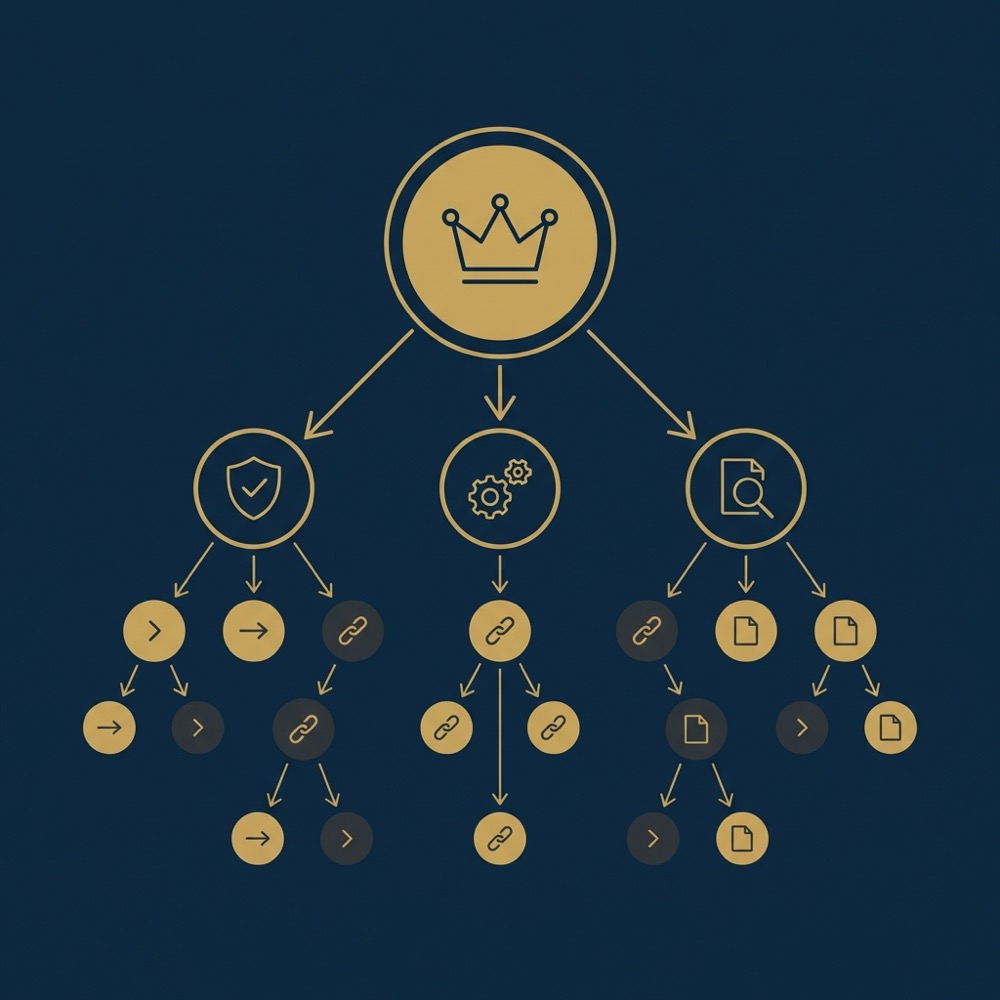
The core assumptions are simple: links carry value, more and better links increase a page's propagated score, and some probability exists that a user jumps to a random page instead of following links. Those assumptions made PageRank distinct from content-only ranking ideas and introduced graph-based reasoning to search.
How the PageRank algorithm works - intuitive and technical overview
Intuition: random surfer and damping factor
PageRank is easiest to visualise with the random surfer metaphor. Imagine a user clicking links at random, occasionally jumping to a new page. Pages that tend to receive more of those random visits gather more propagated authority, and the damping factor controls how much weight follows link paths versus random jumps The PageRank Citation Ranking
PageRank is the foundational model for link propagation; modern SEO uses provider metrics and crawl-aware methods to approximate that propagation and places link work inside broader search architecture and measurement.
A non-technical sketch of the math
Technically the algorithm is iterative. Scores start with a base value. Each pass redistributes score along outgoing links, and repeated passes converge to stable scores. This iterative convergence is what people mean when they say scores propagate through the link graph Stanford technical report
What the score does and does not represent
PageRank-like scores measure link-based influence in a graph. They are not a direct measure of content relevance or user satisfaction. Modern search systems combine link signals with content quality, behaviour data, and machine-learned features.
Why Google no longer exposes a public PageRank score and what Search Central says
Google's stance on links as a signal
Google has long said that links are one persistent ranking signal, but the company stopped publishing a site-level PageRank score and keeps its internal signals private. Official guidance makes clear links remain relevant even as internal measures are not disclosed How Search Works - Google Search Central
Why internal signals remain private
Keeping signals internal prevents manipulation and allows search teams to combine many inputs into robust models. For practitioners this means chasing a single public number is unlikely to map to improved performance; instead, aim for measurable improvements in link quality and how links interact with content and technical structure.
The ecosystem shift: composite, proprietary link metrics and alternatives
Common provider metrics and what they aim to approximate
Since the 2010s the ecosystem moved toward proprietary composite metrics such as domain and page authority, Trust Flow, and provider ranks that approximate PageRank-like influence using crawled graphs and heuristics What is PageRank? - SEO Guide

Why these are approximations, not Google's internal score
Those provider metrics are useful but they are approximations. They rely on independent crawls, sampling choices, and heuristics and therefore correlate with but do not equal Google's internal scoring. Use them as relative measurement tools rather than absolute truth What is PageRank? (and how to estimate it)
How practitioners estimate PageRank-like influence today: methods and tools
Crawl-based sampling and graph-aware metrics

Provider metrics, correlation checks, and practical heuristics
Common heuristics include comparing provider metrics to visibility changes, using Trust Flow or citation measures to spot high-quality referring domains, and running correlation checks to see if link data aligns with organic visibility for target queries Majestic Flow Metrics
These approaches do not recreate Google's internal score. They do, however, give teams a practical signal to prioritise outreach, internal linking, and cleanup work.
What recent studies say about link authority and visibility
Summary of correlation findings
Aggregated studies from 2024 to 2025 find that link authority still shows measurable association with organic visibility for many queries, although the strength of that association varies by vertical and intent Link authority and search visibility study

Limitations and variance by query and content quality
The same studies also show that link impact is conditional. Query intent, on-page quality, and other ranking features change effect size, so a blanket assumption that more links always equals more visibility is not supported by the evidence Link authority and search visibility study
Explore Orvus services for a diagnostic and staged link plan
Run a short diagnostic that samples your high-value pages and checks referring domain relevance, anchor context, and internal link paths.
How link signals should fit into search architecture and measurement
Embed link work in search architecture by mapping how link-driven visibility feeds the funnel. Link signals should be monitored alongside conversion data so teams can connect link activity to downstream outcomes and reporting systems How Search Works - Google Search Central
Reporting and testing link effects in funnels
Use experiments and staged rollouts where possible. For example, add internal links to a subset of category pages, measure relative visibility and conversion changes, and track the similarity between provider link metrics and real traffic signals to validate assumptions Link authority and search visibility study
Good reporting pairs link-focused KPIs with technical health checks, content quality signals, and revenue attribution so that link work is not evaluated in isolation.
Practical link systems: outreach, internal linking, and cleanup
Targeted outreach and topical relevance
Prioritise outreach that targets relevant topical partners and contextual anchors. Quality and relevance tend to matter more than raw counts, so build repeatable processes to find and engage sites that match your content and audience What is PageRank? (and how to estimate it)
Internal linking and site structure
Strengthen internal linking to make sure authority flows where it matters. Intent-driven content architecture and careful internal linking can amplify the benefit of external links and improve crawl efficiency How Search Works - Google Search Central
Disavow and spam cleanup considerations
Monitor referring domains for spammy behavior and remove or disavow harmful links as part of maintaining measurement fidelity. Cleanup is a hygiene step that keeps provider metrics and internal signals easier to interpret Majestic Flow Metrics
Decision framework: when to prioritise link work
Signals that justify investment
Prioritise link systems when diagnostics show that query competitiveness is high, content quality is sufficient, and funnel value from incremental visibility is material. Use crawl coverage and visibility correlation as quick filters Link authority and search visibility study
How to size effort versus other SEO tasks
Balance link work with on-page and technical fixes. If content and technical foundations are weak, spend resources there first. If foundations are solid and visibility stalls, targeted link systems can be the next lever to test How Search Works - Google Search Central
Common mistakes and spam pitfalls to avoid
Quantity over quality traps
Focusing on raw link counts rather than topical relevance often wastes effort. High velocity of low-quality links can also complicate measurement and invite scrutiny from search teams Majestic Flow Metrics
Misinterpreting provider metrics
Provider metrics are approximations. Treat them as directional. Misreading them as exact proxies for Google's internal scoring can lead to poor prioritisation and wasted outreach budgets What is PageRank? - SEO Guide
Over-reliance on single signals
Links are one part of ranking. Overemphasis on links while ignoring content quality, technical health, or measurement gaps is a common error. Combine signals for better decisions.
Short practical scenarios: ecommerce, local service, and content-led sites
Ecommerce example
Ecommerce teams should focus on category and product page internal linking to pass authority where it supports conversion. Pair that work with targeted partnerships in relevant trade publications and suppliers to capture contextual referral value What is PageRank? (and how to estimate it)
Local service provider example
For local services combine local citations with targeted topical backlinks and ensure local landing pages are well structured. That mix helps map link signals into local intent and conversion paths How Search Works - Google Search Central
Content site example
Content-led sites should invest in linkable assets and topical clusters. Outreach to niche publications and internal linking that supports topical hubs helps propagate authority across multiple related pages Link authority and search visibility study
Good reporting pairs link-focused KPIs with technical health checks, content quality signals, and revenue attribution so that link work is not evaluated in isolation.
Conclusion and practical next steps
Summary checklist
Recap: PageRank is the foundational propagation model, but Google uses proprietary, combined signals. Use provider metrics and crawl sampling to estimate influence and always validate with visibility correlation and funnel metrics How Search Works - Google Search Central
How Orvus approaches link systems
Orvus Limited treats link work as systems design inside search architecture, focusing on diagnostics, measurement, and small automations that reduce operational friction. Where relevant, Orvus can help design a diagnostic and a staged approach to outreach and internal linking.
PageRank is the original link analysis model that estimates how authority flows through the web link graph using a damping factor.
No. Google does not publish a site-level PageRank score; practitioners use provider metrics and crawl-based estimates instead.
Fix content and technical issues first; if foundations are solid and visibility stalls, prioritise targeted link systems and validate with diagnostics.
References
- http://ilpubs.stanford.edu:8090/422/1/1999-66.pdf
- https://developers.google.com/search/docs/fundamentals/how-search-works
- our knowledge base
- https://searchengineland.com/backlinks-seo-importance-442529
- https://www.orbitmedia.com/google-ranking-factors/
- our services
- https://loganix.com/google-pagerank/
- orvus.net
Want this kind of work done for your business?
We build and run AI-powered marketing and automation. 15 minutes, honest assessment.
Book a call