 Orvus
OrvusWhat is a search ranking? A guide for operators
January 29, 2026
This guide explains how modern rankings emerge from three systemic stages, the technical signals that enable eligibility, and a repeatable diagnostic workflow for constrained teams. It aims to give clear, practical next steps you can apply within 30 to 90 days.
What is a search ranking? Definition and core ideas
A search ranking is the algorithmic ordering of indexed content by relevance and quality for a user query. This working definition comes from official engine guidance and helps teams focus on what matters operationally, rather than chasing single metrics How Search Works
For operators the practical implication is simple. If a page cannot be crawled or indexed it cannot rank, no matter how good the content is. If a page is indexed but fails to match user intent it will not surface for the right queries. If the page is eligible and relevant, engines then use quality and satisfaction signals to decide order.
Request a consultation with Orvus Limited services
Download a compact diagnostic checklist to prioritise fixes across indexability, relevance, and quality.
Simple definition and why it matters to operators
Defining search ranking this way helps teams link technical work to business outcomes. When you treat ranking as an outcome of systems, you can design measurement that ties position changes to traffic and conversions rather than raw rank alone. Use the definition to decide whether a problem is technical, content, or external signal driven Overview of ranking systems
Three pillars summary: indexing, relevance, quality
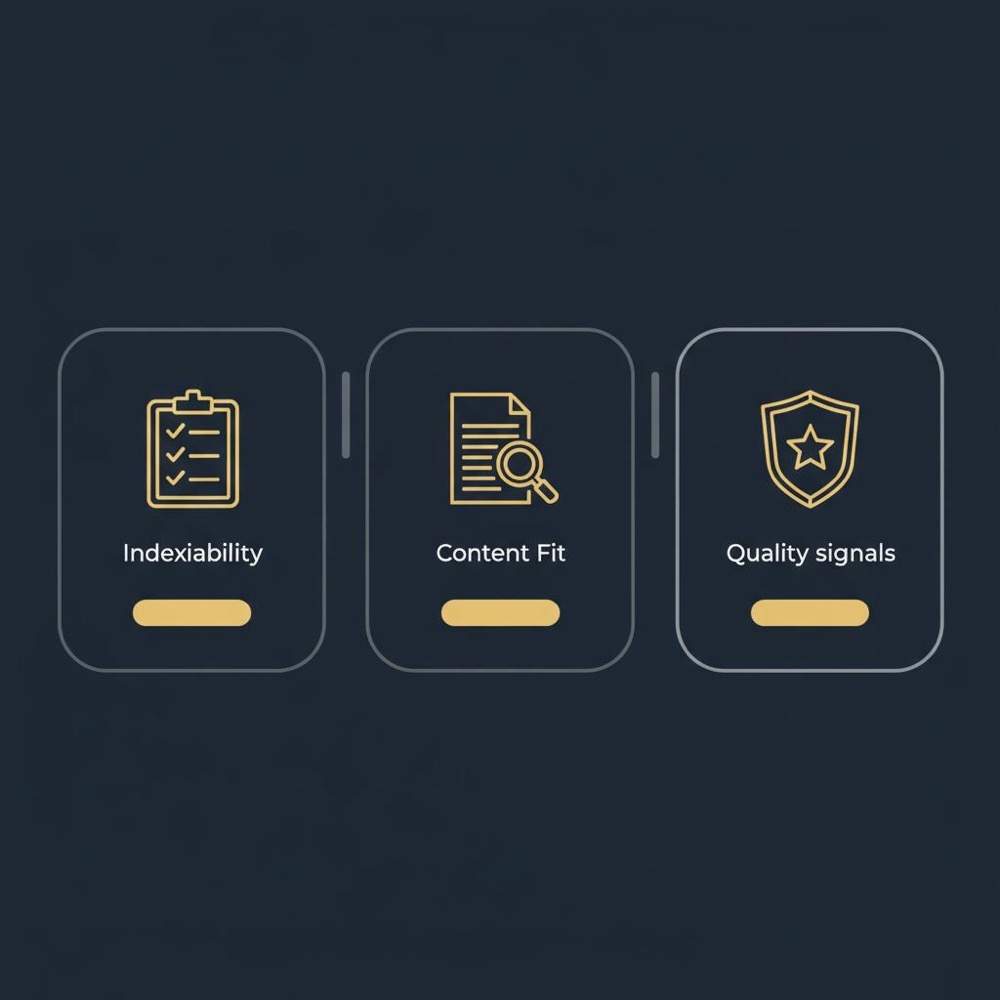
Modern ranking systems typically operate in three practical stages: indexing and crawlability, query to document relevance, and quality or user satisfaction signals. Engines describe these pillars in public documentation but do not publish exact signal weights, so teams should treat pillars as a diagnostic framework not a formula How Search Works
What engines publish and what remains opaque
Search engines publish high level descriptions of how they evaluate pages. They do not disclose precise weights or the full details of proprietary reranking layers. That opacity means correlation studies and foundational retrieval models are useful for interpretation, but operational decisions should prioritise measurable business impact over attempts to reverse engineer exact scores Overview of ranking systems
Stage 1: How engines crawl and index content
Crawlability basics: robots, sitemaps, and renderability
Indexability is the first gate. Robots directives, sitemaps, and the ability for a crawler to render a page determine whether content enters an index at all. If a page is excluded at this stage it cannot appear in results, regardless of its relevance or quality How Search Works
Practical checks are straightforward. Confirm robots directives do not block pages, validate sitemap coverage, and test rendering for the most common user agents and mobile viewport sizes. These checks reveal obvious blockers before you invest in content changes.

Indexing decisions and eligibility
Search engines make indexing decisions about which URLs to retain and which to drop. That process can deprioritise low value duplicates or pages with thin content. Understanding eligibility helps you find why a particular URL never appears for relevant queries Bing Webmaster Guidelines
Remember that being indexed is a necessary but not sufficient condition for ranking. Treat index coverage reports as the first stop in any diagnostic workflow.
Common technical blockers
Common blockers include accidentally blocked resources, meta robots noindex tags, canonical misconfigurations, and pages that require client side rendering but are not server rendered for crawlers. Each of these issues is fixable and often has a large impact on visibility when resolved.
Stage 2: Relevance and query to document matching
Foundational retrieval concepts that power relevance
Relevance is about how well a document matches a query. Foundational information retrieval concepts, such as indexing terms, matching algorithms, and relevance models, still help interpret modern engines even when proprietary ML layers are applied Introduction to Information Retrieval
A search ranking emerges from three stages: whether a page is crawled and indexed, how well it matches query intent, and how quality and user satisfaction signals order eligible pages. Teams should fix indexability first, align content to intent second, and use measurement to link changes to conversions before prioritising external signal work.
How query intent and content mapping interact
Query intent is central to matching. A successful content architecture maps common intents to clear page types. Without a deliberate mapping you create overlap and cannibalisation that confuses ranking systems and users. Start by grouping queries by intent and mapping them to content types that satisfy that intent.
Signals and features that change relevance on modern SERPs
Modern SERPs show many features beyond ten blue links. Featured snippets, knowledge panels, and local packs change how relevance is evaluated for a query. Monitor SERP features alongside position data to understand whether a visibility gain is meaningful for your business Ahrefs blog on ranking factors
Stage 3: Quality and user satisfaction signals
E E A T and why practical quality signals matter
Engines highlight expertise, experience, authoritativeness and trust as quality axes. These quality signals help algorithms decide which pages better satisfy users for higher risk or information sensitive queries How Search Works
For teams this means documenting author credentials, improving factual accuracy, and fixing misleading content where it appears. Use these improvements alongside measurement to see whether satisfaction metrics move.
Backlinks and external signals: correlation and limits
Industry correlation studies show that backlink profiles and on page relevance correlate with higher positions. Those studies, however, demonstrate correlation rather than exact causation, and engines keep their weighting opaque, so use backlink signals as one input among others when prioritising work Ahrefs blog on ranking factors
User engagement and implicit quality feedback
User engagement signals, such as click through rates, dwell time, and pogo sticking, provide implicit quality feedback that engines can use to refine ordering. These signals are noisy but meaningful when observed across many queries and time periods Moz blog on ranking factors
Technical signals that enable eligibility and performance
Core Web Vitals and page experience as prerequisites
Core Web Vitals and broader page experience metrics are treated as prerequisites that affect whether pages are surfaced consistently between 2024 and 2026. Prioritise fixes that remove clear experience blockers before chasing marginal content changes How Search Works See Google's Core Web Vitals guide for an overview of the metrics Core Web Vitals guide and an external explainer Akamai explainer.
Make page experience one part of your eligibility checklist. Improving load behaviour and interactivity can reduce churn in visibility for high value pages.
Core Web Vitals reporting in Search Console can help prioritise pages with poor real world metrics; consult the Core Web Vitals report for field data on affected pages Core Web Vitals report.
Structured data and semantic markup
Structured data helps eligibility for specific SERP features, such as rich results and knowledge panels. It does not guarantee placement but it increases the chance a page will be considered for enhanced appearances when the query intent matches the structured content.
Mobile first rendering and server side issues
Mobile first rendering remains essential. If crawlers cannot access the same content users see on mobile, indexability and relevance assessments can be harmed. Server side issues like erroneous redirects or timeouts also affect crawl budgets and index coverage Bing Webmaster Guidelines

How ranking systems order results today, including ML reranking
Algorithmic ranking signals versus reranking layers
Search engines combine many explicit ranking signals and then apply proprietary reranking layers that often include machine learning components. That layered approach explains why small content changes can sometimes produce disproportionate volatility in results Overview of ranking systems
What engines publish about ordering
Engines publish the conceptual pillars and examples of signals they use. They do not publish exact formulae or relative weights, which is why systematic measurement matters more than attempting to reverse engineer a single score Overview of ranking systems
Sources of short term volatility
Short term volatility can arise from reranking updates, changes in SERP features, broad algorithm updates, or sudden changes in user behaviour. Monitoring volatility alongside traffic and conversions helps distinguish signal from noise.
Measuring search ranking impact: from positions to revenue
Combine rank tracking with SERP feature monitoring
Rank tracking remains useful but incomplete. Combine traditional position tracking with SERP feature monitoring and volatility indicators so you understand whether a position change moves real visibility for users Ahrefs blog on ranking factors
Link organic traffic and conversions to ranking changes
To tie ranking to outcomes, link organic sessions and conversions to ranking events. Look for correlated changes in session volume, conversion rate, and transaction value rather than using raw positions alone Moz blog on ranking factors
Practical metrics and dashboards to prioritise work
Build dashboards that surface pages with high conversion value and low visibility, pages with indexability issues, and queries with sudden volatility. Prioritise pages that affect business metrics first. For practical examples and templates see the Orvus knowledge hub on dashboards useful knowledge.
Decision criteria: when to fix technical issues, content, or links
A prioritisation framework for constrained teams
Start with a simple rule set. If indexability or page experience blocks visibility, fix those first. If a page is indexed but fails intent matching, prioritise content architecture. If competitive backlink gaps align with lost visibility, consider external signal work How Search Works
Signals that push technical work to the top
Index coverage errors, widespread mobile rendering issues, or Core Web Vitals failures on revenue pages push technical fixes to the top of the backlog. Technical fixes are often low ambiguity and high leverage for visibility.
When content architecture or link building is the right axis
When intent analysis shows clear content gaps or cannibalisation, content architecture should be prioritised. When competitors have markedly stronger backlink profiles for target queries, link acquisition becomes a higher priority but treat it as one axis among measurement and content work Ahrefs blog on ranking factors
Typical mistakes and Stolperfallen when teams treat ranking as a single metric
Relying only on position tracking
Tracking positions alone can hide shifts in SERP features and fail to reflect real changes in traffic or conversions. Position is noisy and must be combined with traffic and conversion data to be useful Moz blog on ranking factors
Fixing low traffic pages instead of high value ones
Teams often spend time improving pages that have low business impact. Prioritise pages tied to conversions and revenue before treating low value pages as urgent.
Misattributing seasonality or testing noise to ranking changes
Seasonality and unrelated experiments can mimic ranking effects. Always validate suspected ranking-driven changes with controlled checks against traffic and conversion metrics before large rollouts.
Practical diagnostics: a short checklist to assess ranking problems
Quick technical checks in order
Step one, check index coverage and robots directives. Step two, validate sitemap entries and canonical tags. Step three, test rendering on mobile and major crawlers. These steps catch the majority of eligibility problems How Search Works
Content relevance and duplication checks
Search for intent overlap and content cannibalisation. Compare target queries to page purpose and merge or rework pages where intent conflicts. Ensure headings and structured data reflect the intended query mapping.
Backlink and external signal quick review
Quick backlink checks can reveal clear gaps. Look at the authority of linking domains and the distribution of links across key landing pages. Use backlink signals as a prioritisation input, not a sole driver Ahrefs blog on ranking factors
Scenario 1: ecommerce site with plateaued organic traffic
How to map funnel pages to business outcomes
Map category and product pages to conversion metrics before starting SEO work. Identify which category pages drive most transactions and which product pages act as conversion gates. This mapping keeps work focused on pages that affect revenue Ahrefs blog on ranking factors
Diagnostic path for product listing and category pages
Begin with index coverage and Core Web Vitals on product pages. If product pages are indexed but traffic is low, check intent match on category pages and on-site filtering behaviour. Poor filtering can reduce discoverability and dilute relevance.
Practical prioritisation and measurement setup
Create a small dashboard that links product and category visibility to transactions and average order value. Use that dashboard to prioritise fixes that move revenue relevant metrics first rather than chasing positions for low value queries.
Scenario 2: local service business deciding between content and citations
How to prioritise local intent pages
Local pack visibility depends more on consistent local signals and structured data than on long form content. For local intent pages, ensure NAP consistency, correct schema for local business, and positive signal signals like reviews before extensive content changes Bing Webmaster Guidelines
Signal checks for citations and local pack eligibility
Check citation consistency across main directories and validate local structured data. Use simple call and lead metrics to gauge whether visibility changes translate into business outcomes.
Measurement to avoid wasted effort
Set up conversion tracking for calls and leads and watch those alongside visibility. If citations move but leads do not, reassess whether content or local trust is the limiting factor.
Testing, experiments, and tying ranking changes to outcomes
How to design safe experiments that isolate variables
Design experiments that change one variable at a time on similar pages. Use control groups of pages with similar traffic and intent. This reduces confounding factors and helps you attribute outcome changes more reliably Moz blog on ranking factors
What success looks like beyond positions
Success is improved traffic quality, higher conversion rates or more transactions from organic channels. Positions are a leading indicator at best; measure the downstream business metrics to claim meaningful impact.
Reporting templates that link SEO work to business metrics
Include assumptions and uncertainty in reports. Show which pages were changed, the expected causal path to conversions, and the observed changes in sessions and transactions. This keeps stakeholders aligned on realistic outcomes.
Conclusion: practical next steps and how to use this knowledge
A compact checklist for the next 30 to 90 days
In the next 30 to 90 days, focus on indexability issues on revenue pages, clear intent mapping for the top queries, and a simple dashboard linking organic sessions to conversions. Those three steps create a compounding effect when combined into a routine.
How to combine fixes into a compounding work plan
Bundle technical fixes with targeted content updates and measurement tasks. Fix indexability and page experience first, then align content architecture to queries, and finally monitor external signals and link gaps to refine priorities Overview of ranking systems
When to involve a systems focused partner
Consider a systems focused partner when internal constraints prevent you from linking measurement and execution. A partner can help build repeatable growth systems, dashboards, and small automations that reduce recurring operational work without promising exact outcomes. Consider engaging a partner with a relevant track record such as our team systems focused partner and explore core offers on our homepage Orvus homepage.
A search ranking is the ordered list of indexed pages returned for a query, determined by relevance and quality assessments made by the engine.
No. Improving page speed addresses eligibility and experience signals, which can reduce blockers, but it alone does not guarantee a ranking change without relevance and quality improvements.
Combine rank tracking with SERP feature monitoring and link observed position changes to organic traffic and conversion metrics to assess business impact.
If you need help linking measurement to execution, consider contacting a systems focused growth partner who can help build the dashboards and small automations that reduce recurring operational work.
Want this kind of work done for your business?
We build and run AI-powered marketing and automation. 15 minutes, honest assessment.
Book a call