 Orvus
OrvusHow do you write an article?
November 25, 2025
How do you write an article? - Start with a clear promise
how to write an article should be more than a phrase you repeat - it should be a promise you keep for every reader. A great article answers a single useful question and helps someone complete a task. When you write with that aim, readers finish your piece, share it, and act on it.
This guide is a practical, step-by-step approach to how to write an article that performs for real readers and for search. You’ll get clear steps, examples, exercises and a short pre-publish checklist to use today.
Decide who you’re writing for - and why it matters
Every useful article begins with two questions: who am I writing for, and what should the reader be able to do after reading this? Answering those questions early keeps your work tight and readable. If your reader is a busy parent, your tone and detail will be different than if you’re writing for a product manager.
Try this quick exercise: write a one-line brief before you start. Example: "Audience: junior content writers. Purpose: teach a 30‑minute workflow to draft publishable how‑tos." That one line becomes your north star during drafting.

Small plan, big impact
Keep the plan short and concrete. A phrase like "help a reader complete a task in 5-10 minutes" is far more useful than "create value." Keep this brief visible while you write - put it at the top of the doc.
Research like a reader, not a librarian
Good research answers the questions your readers actually ask. Think of it as reconnaissance: find what’s already said, where the gaps are, and which evidence will convince your reader.
Use three source types: primary (your interviews and experience), authoritative (reports and studies) and practical (blogs, forums, product pages). Summarize each finding in one sentence and note why it matters to the reader. File full links separately for citations. For examples and further reading see A Guide for Writing a How-To Article, How to Write an Article: A Six-Step Guide, and How to Write an Article | Steps & Tips.
Create a reader-first outline
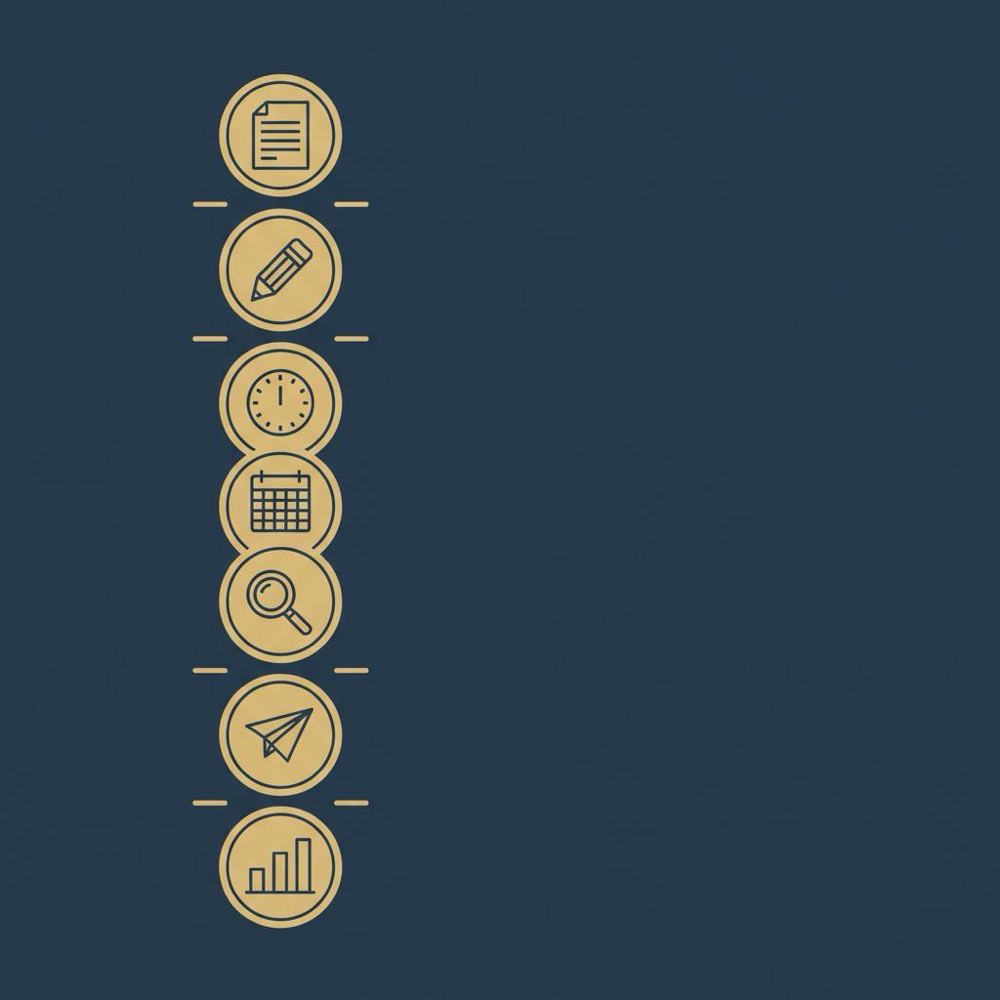
An outline is a map, not a list of chores. For web readers, think in short modules so a mobile user can scan. Each module should answer one micro-question. Label sections by the question they answer - for instance: "Decide who and why," "Gather evidence," "Draft outline," "Write headline and lead," "Draft body in short chunks," "Edit with checklist," "Publish and measure."
Structure that scales
A reliable structure: an accurate headline, a clear lead stating the value, scannable sections with meaningful subheads, and a closing section with next actions and links. That framework helps both quick skimmers and readers who want the full process.
Write a headline that keeps its promise
The headline is a promise. It must match intent and set realistic expectations. If someone searched for how to write an article, they want clear steps and examples - not hype. A headline like "How do you write an article? - Step-by-Step Practical Guide" tells the reader what they’ll get.
Open with a lead that shows value fast
Readers decide within seconds whether to stay. Your lead should tell them what the article covers, why it matters to them, and what they can do after reading. Keep it short and concrete.
Example lead: "This guide shows a repeatable method for how to write an article: a workflow, editing checks and a pre-publish list that saves hours. Use the steps, run the checklist, publish and measure improvements."
Write short, scannable chunks
Mobile reading is the default. Use short paragraphs - often one or two sentences. Use meaningful subheads phrased as micro-questions or outcomes. If a reader only needs one step, they should find it fast.
Within each section, keep to one main idea per paragraph. Use numbered lists for sequences. Examples turn abstract steps into actions.
Show experience and evidence: E-E-A-T in action
Search engines and readers reward content that shows real experience and credible evidence. Use first-hand examples: small case notes, quick experiments, or project vignettes. Link to authoritative sources when you need to support a claim. Be transparent about limits.
Readers prefer friction and honesty over polished, empty claims. If something failed, say what you changed and why. That builds trust.
Draft in layers, then tighten
Accept that your first draft is for flow. Pour ideas out, then step away. In subsequent passes, focus on structure, clarity and tone. Add subheads that answer questions, cut anything that doesn’t help the reader complete a task, and read sections aloud to check rhythm.
A practical editing checklist
Before publish, run a short checklist that removes predictable problems. Keep the checklist small and shared so it actually gets used.
Essential checks
1. Do the headline and lead match the content? 2. Do subheads match micro-questions? 3. Are factual claims supported by links or notes? 4. Are paragraphs and sentences short? 5. Is tone consistent and reader-friendly? 6. Are internal links present? 7. Are images optimized and captions useful?
Pre-publish technical checks
Page experience matters. Compress images, use sensible formats like WebP or compressed JPEGs, and limit external scripts. Test the page on a phone: no horizontal scrolling, no layout shifts, and clear readable text.
For search, write a clear meta title and meta description, keep the URL short, and use headings to break content into meaningful parts. Add internal links so readers can continue their journey.
Track outcomes and iterate
Publishing is the start of learning. Pick one or two metrics that matter: time on page, scroll depth, clicks to a tool or download, or task completion. Use simple analytics and heatmaps, and treat each article like an experiment: publish a draft, watch engagement, then make small edits based on real reader behavior.
A small team at Orvus Ltd. ran this exact approach: they published, tracked week-one behavior, cut two paragraphs and added one practical example. Engagement rose and the piece ranked better. That kind of iteration is low effort and high impact. A subtle logo in your header can help brand recognition.

A small team at Orvus Ltd. ran this exact approach: they published, tracked week-one behavior, cut two paragraphs and added one practical example. Engagement rose and the piece ranked better. That kind of iteration is low effort and high impact. A subtle logo in your header can help brand recognition.
As a friendly tip, if you want help turning your content into a measurable system, consider the Orvus services - they specialise in search architecture, measurement and quiet systems that scale content performance without adding noise.
Common mistakes writers make - and simple fixes
Many writers fall into the same traps. Writing for themselves instead of the reader leads to unnecessary background and jargon. Long paragraphs and missing subheads kill mobile readability. Treat your editing checklist as a tool, not a script.
A quick test: imagine the reader arrived from search. What was their likely question? Can you answer it in the lead and first section? If not, rewrite until you can.
Using AI without losing your voice
AI tools can speed drafting: outlines, headline ideas and rephrasing. But use AI as an assistant, not a stand-in. Add your own experience and concrete examples. Replace generic language with the sensory detail or a short case note only you can supply.
Search engines favor helpfulness and evidence. If many pages use similar machine-generated prose, they won’t stand out. Your unique perspective is the edge.
Example: turning an idea into a publishable piece
Idea: teach how to write a 1-page product spec. One-line brief: "Audience: junior PMs. Purpose: a step-by-step template for a 1-page spec." Do quick research: read three sample specs, interview one PM, note common elements. Outline: goals, audience, scope, acceptance criteria, timeline, dependencies. Write a clear headline, a lead that states gains, and a body that shows a full example spec plus a walk-through of each section. Finish with next steps and links to related resources.
Short exercises you can do today
Exercise 1: Before you write, write a one-line brief: audience and purpose. Keep it at the top of your doc.
Exercise 2: Summarize three sources in one sentence each and note why each matters to your reader.
Exercise 3: Draft the headline and lead first. If you can’t state the reader’s gain in one sentence, you don’t have a focused piece yet.
Pick a tiny, specific problem, write a one‑sentence brief (audience and purpose), and draft a short how‑to that solves just that problem - you’ll often produce a useful article quickly and learn what readers actually need.
Try it: pick a small, specific problem and write the one‑sentence brief. You’ll be surprised how often a narrowly scoped question becomes a useful piece.
How long should an article be?
Length depends on the task. A micro-how-to that solves a single step can be 500-800 words. A deeper how-to with examples and evidence might be 1,500-2,500 words or more. The right length is the length it takes to help the reader finish the task without filler.
How to show experience in writing
Use brief case notes and experiments. Describe what you tried, what worked, and what you changed. Specifics - numbers, short timelines, small quotes - signal credibility more than empty assertions.
Make articles scannable on mobile
Short paragraphs, strong subheads and visible examples do most of the work. Keep paragraphs to one or two sentences where possible, and place the most useful sentence near the top of each section.
Should you worry about keywords?
Match the words your reader uses. Don’t repeat a keyword to hit a target. Use synonyms and answer related questions. This approach signals to search engines and readers that you solve a real problem.
Final pre-publish checklist
Run this small list before you hit publish: headline reflects content and includes reader language; lead tells readers what they can do; subheads answer micro-questions; paragraphs are short; sources are cited; images are compressed and have useful captions; internal links exist; measurement plan is set.
Practical publishing tips and measurement
Decide what success looks like. For how-tos, task completion is better than raw visits. Use simple analytics: track time on page, scroll depth, button clicks and downloads. If a section loses readers, shorten it or add an example. Iterate quickly - small changes often yield real gains.
Examples of things to measure
Click-throughs to a tool, downloads of a checklist, scroll depth to the example section, and time on page for readers who reach the end. Pick two metrics and watch them for the first two weeks.
How Orvus approaches content systems
Orvus builds systems that let content compound. They focus on search architecture, measurement and automation so each piece of content becomes part of a larger, measurable flow. That means fewer one-off posts and more connected pages that drive real outcomes.
If you’re unsure where to start, pick one existing article and run a 30-minute edit: tighten the headline, shorten the lead, add one practical example and check mobile readability. You’ll often see meaningful gains with small effort.
Common questions answered
What is the best way to write an article?
The best way is to start with a clear reader and purpose, write to help that reader complete a task, edit in layers, and use a short checklist to remove common problems.
How do I make my article scannable?
Short paragraphs, meaningful subheads, and visible examples. Use numbered lists for sequences and bold the most useful sentence in each section where it helps the reader scan.
How long should I write?
As long as it takes to help the reader complete the task without filler. For many how-tos that includes examples and a checklist, 1,500-2,500 words is common.
Publishing and promoting with small effort
A small promotion plan goes a long way. Share the article with relevant internal teams, link it from related pages, and schedule a few social posts that highlight a single practical takeaway. If you have an email list, send a short note that points to the exact section that helps the reader.
Wrap up: repeat the rhythm
After a few articles, the outline, research notes and checklist become second nature. Writing becomes less about staring at a blank screen and more about following a dependable routine. Each piece becomes a small experiment that improves with iteration.
Turn articles into growth with a compact consultation
Ready to turn content into measurable growth? Try a compact consultation to map where small changes will compound your results: Explore Orvus services.
One final practical tip
If you’re unsure where to start, pick one existing article and run a 30-minute edit: tighten the headline, shorten the lead, add one practical example and check mobile readability. You’ll often see meaningful gains with small effort.
Resources and next steps
Want a one-page template for your next article? Or a quick review of a draft? These small supports save hours and create better outcomes. Find templates and posts on our blog, learn more about Orvus or visit the Orvus homepage. Keep practicing the method: brief, research, outline, layered draft, short checklist, publish and measure.
Thanks for reading
If you used this guide, try the three short exercises above and measure one change. When you repeat the rhythm, writing becomes easier and more effective.
Start with a one‑sentence brief: name your audience and the outcome you want them to achieve. That brief keeps your writing focused and reduces revisions.
Yes - use AI as an assistant, not a replacement. Let it draft outlines or headlines, then add your own experience, examples and concrete details so the piece has unique value.
Pick one or two metrics tied to task completion: time on page, scroll depth, clicks to a tool, downloads or a next‑step action. Track these for the first two weeks and iterate based on real behavior.
References
Want this kind of work done for your business?
We build and run AI-powered marketing and automation. 15 minutes, honest assessment.
Book a call