 Orvus
OrvusHow much does Shopify take from a $100 sale?
November 25, 2025
How much does Shopify take from a $100 sale?
Short answer: it depends on your setup - but a typical Shopify Payments charge in the U.S. on a Basic plan costs about $3.20 (2.9% + $0.30), leaving you with roughly $96.80 from a $100 sale. Use of third-party gateways, higher card rates on different plans, and plan subscription fees change that number.
That practical calculation is important, but it’s only half the story. Fees do more than hit your margin: how you communicate them, who pays for them, and how clearly you present pricing influences customer trust. This article answers the fee question in concrete examples and then walks through why transparency and small, repeatable actions build trust that keeps customers coming back.

Why the fee question matters for small brands
When you ask, "How much does Shopify take from a $100 sale?" you’re really asking two linked things: how much money you keep, and how that number affects the experience you promise. Hidden costs, surprise fees at checkout, or an opaque refund policy can erode the trust you’ve worked to build with product photos, stories, and reviews.
We’ll start with clear, simple examples, then move into the trust playbook every small business can use to keep customers-and margins-happy.
Common fee scenarios: real examples
Below are typical fee calculations for a $100 online sale. These figures are examples (card rates vary by country and merchant agreement), but the math shows how different choices affect the final payout. For background on how card-processing fees are built up, see Shopify's guide to credit card processing fees.
Scenario 1 - Shopify Payments (Basic plan) - typical U.S. online card rate
Rate: 2.9% + $0.30 per transaction (example)
Calculation: 2.9% of $100 = $2.90 + $0.30 = $3.20
Net to merchant: $100 - $3.20 = $96.80
Scenario 2 - Shopify Payments (Standard/Shopify plan)
Rate: 2.6% + $0.30
Calculation: 2.6% of $100 = $2.60 + $0.30 = $2.90
Net to merchant: $97.10
Scenario 3 - Advanced plan (lower card rate)
Rate: 2.4% + $0.30
Net to merchant: $100 - ($2.40 + $0.30) = $97.30
Scenario 4 - Using a third-party payment gateway
If you use a third-party processor (Stripe, Adyen, PayPal, etc.) in place of Shopify Payments, Shopify historically charged an extra transaction fee on some plans (anywhere from 0.5% to 2%). If you’re on a Basic plan and pay 2% in Shopify transaction fees in addition to the card fee, that’s:
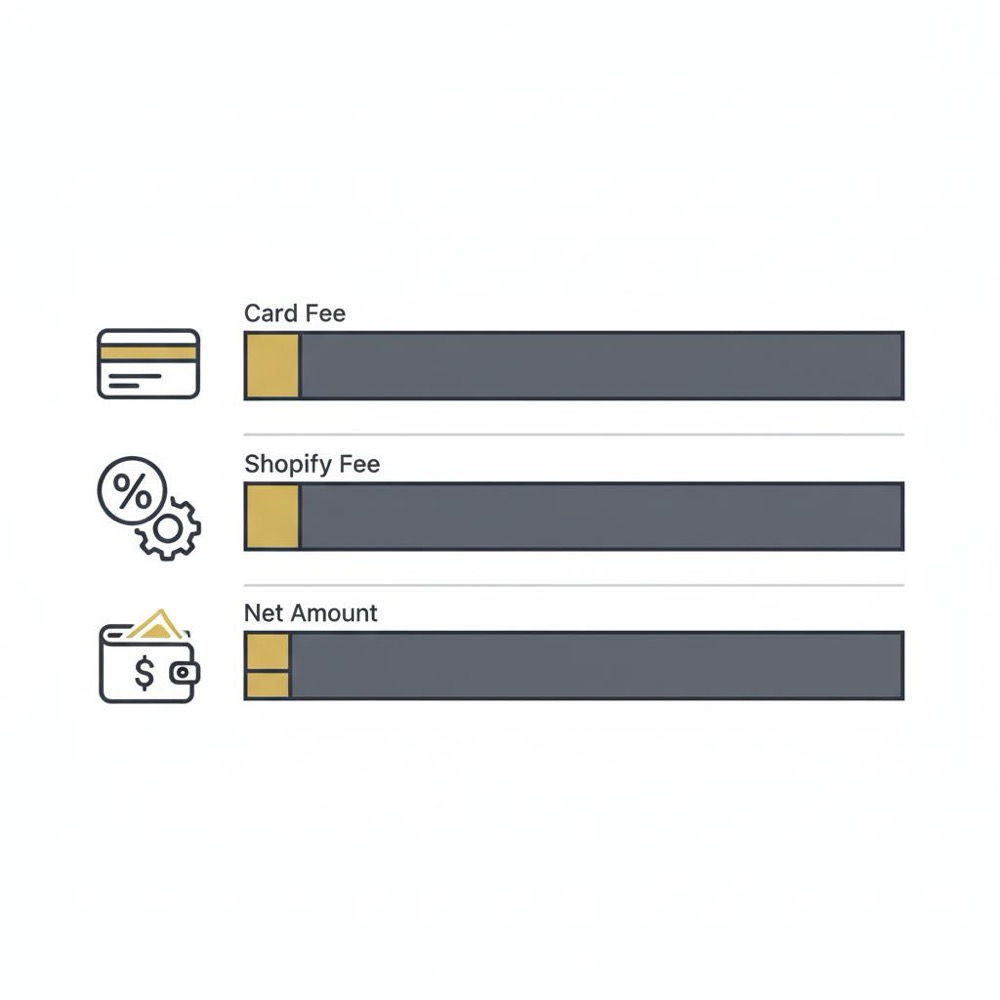
Card fee (2.9% + $0.30) = $3.20
Shopify transaction fee (example 2%) = $2.00
Total fees: $5.20
Net: $94.80
Remember: exact rates and the availability of Shopify Payments depend on country and business type. The example numbers above are illustrative and explain the mechanics-your contract may differ. For a broader set of merchant-level observations and analysis, see this detailed analysis of Shopify costs.
Other costs to consider (affecting the true take-home)
Think beyond the per-transaction card fee. A single $100 sale might also be affected by:
- Monthly Shopify subscription (Basic, Shopify, Advanced) - divide that monthly cost across your expected sales to see the per-sale impact.
- App fees for tools that help conversions, shipping labels, or recurring orders.
- Shipping costs and fulfillment labor that may be paid by you or partially covered by the customer.
- Refunds and chargebacks, which can reverse revenue and cost fees.
For example, if your plan costs $39/month (Basic) and you do 100 sales per month, that’s an extra $0.39 per sale to allocate. If you do 1,000 sales, the per-sale impact shrinks - which is why per-sale economics change as volume improves.
How much does Shopify take from a $100 sale? - The transparency angle
Now let’s loop this back to trust. If a customer sees a $100 price and then the checkout adds a surprise $8 shipping or a confusing tax line, trust drops. Conversely, if you present a clear total price and explain fees (or what the customer is getting for the price), you reduce anxiety and friction.
Being transparent about pricing-even if you choose not to break down every card-processing fee-builds trust. Customers react to surprises more strongly than to the size of the final charge. A clean, honest checkout feels like stepping into a neat, well-lit shop: it lowers resistance and leads to higher conversion and better word-of-mouth.
Practical ways fees and trust intersect
- Show estimated shipping and taxes earlier in the funnel to avoid cart abandonment.
- Offer price-inclusive displays for some markets ("$100 total") so customers don’t feel nickeled and dimed.
- If you apply a surcharge for certain payment methods, explain why and offer alternatives.
And remember: you do not need to show the card-processing math. You do need to be honest about the final total and any chosen surcharge policies.
Data point: why clarity compounds
When customers feel confident about the price and delivery timing, they are more likely to buy again and to leave useful reviews with photos-these are the same actions that build trust in the long term.
One way to get clearer on what to change is to use practical diagnostics from specialists like Orvus’s services. They help brands identify the few changes that compound-like clearer product descriptions, faster response times, and simplified return pages-without adding noise.
Trust isn’t one big thing - it’s a thousand small choices
Trust is a stack of small consistent actions: clear product descriptions, honest photos, predictable delivery, readable return policies, and a human voice in customer replies. Fees fit into that stack: if you price fairly and explain clearly, customers focus on product value, not accounting minutiae.
Clarity: how to write product pages that reduce doubt
One of the simplest trust-building moves is clarity. Here’s a checklist you can apply right now to a product page:
- Concrete specs: dimensions, weight, materials, and care instructions.
- Accurate photos: multiple angles, at least one real-use shot with a common object for scale, and a short video if possible.
- Fit and sizing: say if something runs small or large and provide a size chart.
- Shipping estimates: show expected delivery windows and handling times.
- Returns and guarantees: link to a plain-language policy and summarize the key points on the page.
Small details matter. When a shopper can picture the package arriving, the product in their home, and the returns process, the decision point moves from "Should I buy this?" to "Which color do I want?" That's trust in action.
The quiet power of responsiveness
Quick, human responses matter. They signal competence and care. A small shop can make responsiveness a competitive advantage by setting a visible promise (e.g., "We reply to messages within 4 hours on weekdays") and meeting it. Publish that promise where customers see it-on the contact page or footer-and follow through.
Not necessarily. Fees exist to cover payment processing and platform costs. The bigger risk to trust is surprise charges and opaque pricing. Be transparent about totals, offer clear shipping and return information, and test whether inclusive or line-item pricing works better for your customers.
When answers are promised and delivered quickly, customers are less likely to abandon carts and more likely to come back. This is part of the same ecosystem that includes clearly displayed fees: predictability reduces friction.
Security and privacy as baseline trust
Customers must feel confident their payment and personal data are safe. Use well-known processors, show security indicators, and write a readable privacy policy that explains:
- Which data you collect and why
- How long you keep it
- How a customer can control communications
Say the above in plain language and avoid legalese. A short line like "We never sell your email address" is more useful than paragraphs of legal jargon for most buyers.
User-generated content and social proof
Stars help, but real value comes from rich reviews-photos, videos, and context. After each purchase, ask targeted questions that lead to useful reviews: "Did the product arrive on time? Was the packaging intact? How did it look in your home?" The richer the review, the more convincing it is to new buyers.
Transparency when things go wrong
Errors are inevitable. The difference between a recoverable misstep and a lasting reputation issue is how you respond. Admit what happened, explain the fix, and follow through. A personal note and a small gesture (discount, free return label, or replacement) often transform anger into appreciation.
Customer service as a promise kept
Make promises you can keep. If your product page says "ships in 24 hours," make sure operations support that claim. Train whoever answers customers to listen first, clarify, and summarize a next step. Canned responses are fine for scale, but edit them so they sound human.
Design, functionality, and perceived competence
Slow pages and inconsistent design create suspicion. Aim for a coherent visual language and a mobile experience that’s as good as desktop. Navigation should be obvious; contact info should be visible; checkout should be quick. People assume a tidy website reflects a tidy business.
Logistics: fulfillment that keeps promises
Reliable delivery is invisible when it works and dominant when it doesn’t. Be honest about delivery windows, use tracking with predictable steps, and communicate early if delays happen. Small gestures can go a long way: a partial refund for a delayed order or a handwritten note in the box turns an annoyance into a human moment.
Pricing and fairness
Fairness matters more than the absolute price. If you charge more than mass-market alternatives, explain why. Are your materials sustainable? Are you supporting local artisans? Share that context and customers will often pay more willingly.
Community and relationship building
Community is trust magnified. Encourage customers to share photos, host Q&A spaces, and highlight customer stories. That social proof reduces the perception of risk for new customers.
Measuring trust: practical signals to track
Trust is intangible, but trackable signs include:
- Repeat purchase rate
- Customer lifetime value (CLV)
- Return/complaint rates
- Review sentiment and NPS
Start with two signals (e.g., repeat purchase rate and average review rating). Focus on improving those and watch for compound effects.
A quiet case study - Orvus Ltd.

Orvus Ltd. refined product pages, simplified returns, and sped up responses. They also asked one simple follow-up question after every purchase: "Did this meet your expectations?" The answers-especially photos and descriptions-helped tweak listings and packaging. The result was steady improvement in repeat purchases and public reviews. The lesson: small, consistent acts compound into durable trust.
Practical rituals to adopt this week
Try these three practical moves:
- Run a user test of your top three pages. Watch where people hesitate and fix those points.
- Write a plain-language returns policy and place it where customers can find it in two clicks.
- Publish a response-time promise and meet it.
These habits create visible accountability that customers notice and appreciate.
Handling negative reviews
Respond promptly and politely. Acknowledge the issue and offer a remedy. If a review is abusive or false, remove it under platform rules and explain briefly why it was removed. Deleting reasonable criticism, however, looks evasive.
Putting the Shopify fee answer into practice
Knowing how much Shopify takes from a $100 sale helps you price clearly, set expectations for margins, and decide whether to absorb fees, pass them to customers, or split costs. Here are practical next steps:
- Calculate your net per sale after card fees and Shopify transaction fees.
- Include per-sale allocations for monthly subscriptions and average app costs.
- Decide on an explicit policy: do you include shipping in price, charge separately, or offer free shipping over a threshold?
- Test messaging: show a single "price total" or show a line-by-line breakdown and measure conversion.
Orvus focuses on a compact diagnostic and then a small set of high-leverage moves-architecture, measurement, creative, and automation-that work with your real constraints. For merchants wondering how fees affect their margins and how to present pricing clearly, Orvus is a pragmatic partner that prioritizes clarity and compounding improvements.
Small, practical audits that compound
If you want a short, practical audit to prioritize the two or three changes that will move the needle, consider a tactical review by Orvus’s growth services-they specialize in turning small fixes into lasting improvements.
FAQ
How long does it take to build trust online?
Trust builds over time. Some changes (clear descriptions, readable returns) show immediate gains. Reputation for reliability takes months or years of consistent action. The key is steady, repeatable behavior.
What if I can’t afford premium packaging or glossy photos?
Honest, well-lit photos and tidy packaging go a long way. Authenticity outperforms polish for many niche audiences; show the real product plainly and focus on clarity.
Should I show negative reviews?
A mix of reviews increases credibility. Perfect scores can feel fake. Respond constructively to negatives and use them to improve.
Closing thought
Small businesses win when they treat trust as a practice: clear language, honest pricing, quick replies, and careful fulfillment. Knowing exactly how much Shopify takes from a $100 sale is practical-useful for pricing-but the larger win is in how you present that price and make the purchase predictable and human.
Card fees (like 2.9% + $0.30 on a Basic plan in the U.S.) are deducted per transaction and reduce your immediate payout. Add any Shopify transaction fees (when using third-party gateways) and divide monthly subscription costs across expected sales to calculate your true per-sale margin.
There’s no single answer. Absorbing fees can be simpler and feel more customer-friendly; passing them on can protect margins. Test both approaches, and be sure to communicate clearly-customers prefer predictability over surprises.
Yes. Orvus specializes in practical audits that identify two or three high-leverage moves (within 30-90 days) to improve conversion, clarity, and operational efficiency-helping protect margins without unnecessary complexity.
References
Want this kind of work done for your business?
We build and run AI-powered marketing and automation. 15 minutes, honest assessment.
Book a call