 Orvus
OrvusWhat do SEO freelancers do?
December 10, 2025
What do SEO freelancers do? At a glance, they turn messy search problems into tidy, repeatable systems that move real business metrics. Today, a freelancer is less a one-off fixer and more a compact growth partner: someone who can diagnose, implement, and leave behind the processes and measurement that make improvements stick.

Why hire an SEO freelancer now?
Companies hire freelancers because flexibility and speed still matter. Freelancers can be nimble - moving quickly to fix urgent crawl issues, set up measurement, or run a focused content pilot. But the best freelancers offer more than speed: they design systems that keep working after the engagement ends.
What to expect from modern freelance SEO
Modern freelance SEO often bundles a number of services. Instead of a single task, top freelancers offer a layered approach: technical diagnostics, measurement sanity checks, prioritized on-page improvements, strategic content mapping, and targeted outreach. You get a mix of immediate tactical wins and medium-term projects that compound over months.
Focus on outcomes: Whether your goal is more organic revenue, better local visibility, or fewer product support tickets, tell candidates the metric you care about first. That shapes how they scope work and measure success.
Common freelance SEO tasks and how they fit together
Below are the most common freelance SEO tasks you’ll encounter - and how they typically interlock in a sensible engagement.
1) Technical audits
Freelancers run crawls, inspect indexing, review canonicalization and redirects, and identify speed and mobile issues. A diagnostic output usually includes prioritized fixes, estimated effort, and who should own the work (engineers, CMS admin, or the freelancer).
2) Analytics and measurement setup
Setting up GA4, Search Console, tagging and events, and dashboards is fundamental. If you can’t measure it, you can’t prove it. Freelancers will often provide a measurement checklist: key events, conversion definitions, and a plan for cohort or assisted-conversion analysis.
3) Content strategy and content briefs
Content isn’t just blog posts; it’s a map of intent, topics and funnel stages. Freelancers create content frameworks, editorial calendars and detailed briefs that make it easier to produce content that ranks and converts.
4) On-page optimization
Title tags, meta descriptions, schema, internal linking and content structure are classic on-page tasks. The goal is to improve relevance and click-throughs while avoiding brittle, one-off changes that don’t scale.
5) Link acquisition and outreach
Quality over quantity is the rule. Freelancers focus on reputable placements and relationship-led outreach: editorial links, partnerships, and content collaborations that withstand algorithm changes.
6) Local SEO (when relevant)
For local businesses, freelancers tidy up Google Business Profile listings, citations, local content and review management so searches translate into real visits and calls.
7) Automation and light tooling
Many freelancers use automation for reporting, issue tracking and content workflow. They’ll often create small scripts or templates to reduce repetitive work and free up time for strategic tasks.
How freelancers price work - and what it means for you
Pricing matters because it shapes incentives. Freelancers charge hourly, by fixed-price projects, or on monthly retainers. Each model is appropriate for different problems:
Hourly
Good for diagnostics, quick fixes, or short troubleshooting. Hourly work rewards time and can be useful when scope is uncertain.
Fixed-price
Best for well-scoped deliverables like a migration plan or a technical audit. You get a clear output but may need to implement or iterate yourself.
Monthly retainer
Retainers connect discovery and execution. If you want ongoing content, link work and iteration, a retainer creates space for learning and improving over time.
Practical tip: a hybrid model - a short fixed diagnostic followed by a retainer - is often the most effective way to reduce risk and align incentives.

AI: speed with guardrails
Use AI for first drafts, outlines and idea generation. Keep human editors for subject accuracy, tone and depth. The risks are policy changes and updates targeting low-quality or formulaic content - so editorial oversight matters.
Measuring content ROI in GA4 - practical approaches
Measuring content ROI is nuanced. GA4’s event-driven model is powerful but needs careful setup. Relying solely on last-click conversions misses the bigger picture. Freelancers typically build a measurement mix:
Assisted conversions and multi-touch paths
Micro-conversions and engagement events (downloads, time-on-page, form start)
Cohort analysis for content-first users
Custom attribution windows (90+ days for many B2B flows)
Tip: ask for a sample dashboard or a short cohort analysis in your trial diagnostic so you can see how content influences downstream metrics. For practical guides on measuring ROI and content performance, see How to Measure & Improve Marketing ROI in 2025, Measuring Content ROI: 4 Key Metrics for SEO Success, and What Is Your SEO's ROI?.
Scoping discovery vs. execution in short engagements
Short sprints are common, and they work when scoped tightly. Timebox discovery and deliver a handful of outputs that are immediately actionable: prioritized technical fixes, a short content map, and a measurement checklist.
Example 3-week sprint:
Week 1: Technical triage + analytics sanity check.
Week 2: Content and keyword triage + one pilot piece.
Week 3: Handoff document + seven-item execution plan + retainer proposal.
Practical tip: a hybrid model - a short fixed diagnostic followed by a retainer - is often the most effective way to reduce risk and align incentives.
If you want a structured diagnostic that ties SEO to revenue and leaves a repeatable measurement system behind, consider working with Orvus - learn more at Orvus services, where diagnostics, architecture and measurement are built to fit your business constraints.
How to choose the right freelancer
Start with outcomes. Define the metric that matters - organic revenue, demo sign-ups, local calls, or fewer support tickets - and ask candidates how their plan drives that outcome. You can also learn about the team's background at Orvus.
Interview checklist
Ask for:
Specific examples with dashboards showing traffic, conversions and timelines.
Sample audit or report (sanitized) so you can evaluate clarity and handoff quality.
References who can explain how the freelancer worked with internal teams.
Details on toolstack and process for tagging, events and reporting.
Red flags to watch for
Steer clear of anyone promising instant top rankings, or who shows only keyword rank screenshots without traffic or conversion context. Watch for volume-first link promises and for freelancers who don’t document decisions or provide handoff artifacts.
Pricing scenarios by company size
Expect different ranges based on needs:
Small local business: diagnostic and GBP cleanup in a low four-figure fixed fee; local retainers in the low four-figures.
Growing SMB: broader work with monthly retainers often in the mid four-figures to five-figures.
Strategic/large engagements: senior consultants and embedded work priced higher with monthly retainers.
How to structure a clean freelance engagement
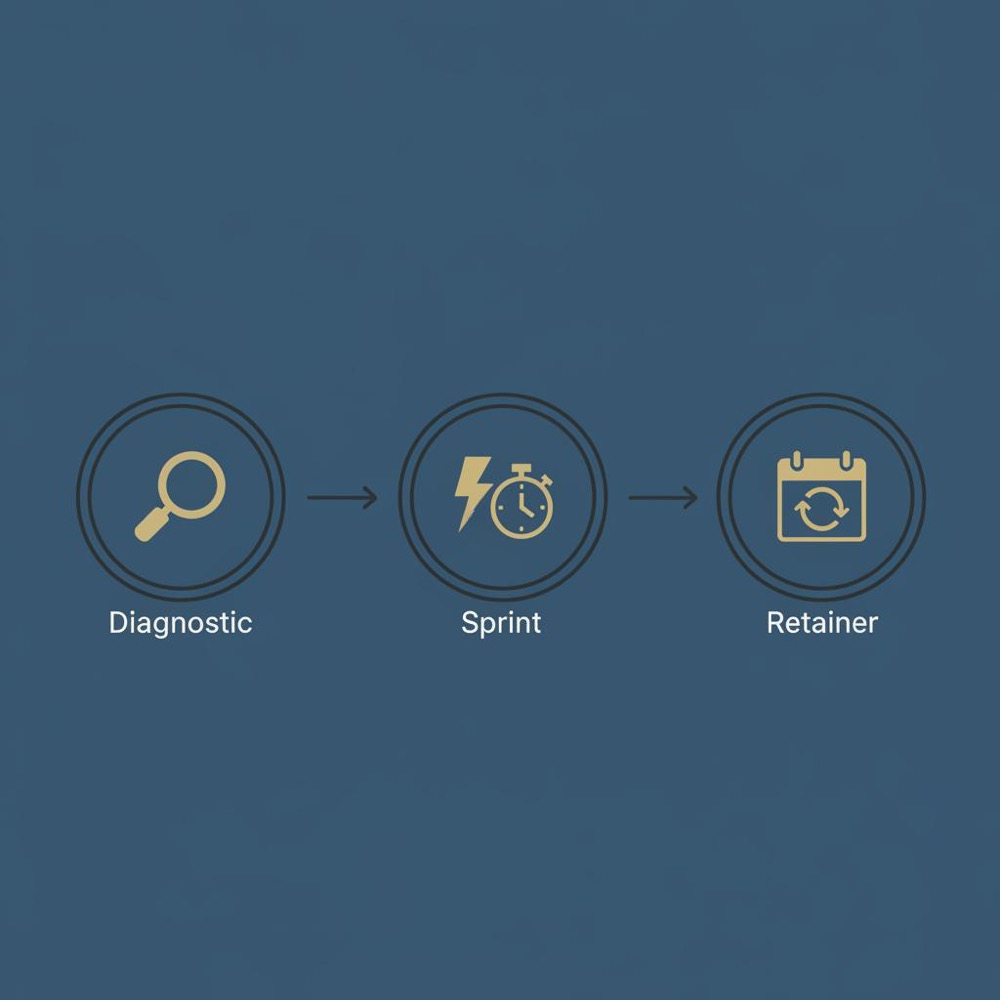
I recommend a three-part structure: diagnostic, sprint, retainer. This gives clarity and momentum and ties short-term fixes to long-term iteration.
Diagnostic (compact)
Analytics sanity check, crawl of critical sections, prioritized quick wins, and an implementation plan with owners.
Short implementation sprint
Fix the highest-return items, set up conversion events, and publish a pilot content piece to test assumptions.
Retainer phase
Ongoing content production, link work, measurement and iteration. This is where systems start to compound.
Contract checklist and scope items
Include:
Clear deliverables and acceptance criteria.
Access requirements (Search Console, GA4, server logs, CMS).
Change control for out-of-scope work.
Reporting cadence and one objective metric for success.
Editorial ownership and IP for content.
Practical onboarding checklist
Make onboarding fast and painless with this checklist:
Grant Search Console & GA4 access.
Share CMS credentials or a limited user account for implementation.
Provide one internal contact and an engineering ticketing channel.
Share current content calendar and analytics goals.
Negotiation tips
Be explicit about payments for milestones and include a short trial diagnostic before committing to a longer retainer. Timeboxed pilots reduce risk and give both sides a clean decision point.
How to get the most from a freelancer
Keep them close to decision-makers, give them the data they need, and treat the first diagnostic as an experiment with clear acceptance criteria. Prioritize the handful of changes that unlock more capacity - canonical fixes, analytics hygiene, or better internal linking.
AI and ethics - what to ask
Ask candidates how they use AI. The best freelancers use AI to speed drafting and research, but keep subject-matter experts and editors in the loop for accuracy and depth. Ask how they ensure content quality and how they avoid policy violations from platform or search updates.
Predictability comes from systems: a clean technical foundation, reliable measurement, and content tied to intent and funnel stages. A freelancer who documents workflows, provides dashboards, and hands over a prioritized backlog ensures future wins are repeatable rather than accidental.
The short answer: systems. Predictability comes when technical foundations are healthy, measurement is clean and content work is tied to intent and funnel stages. A freelancer who leaves behind dashboards, documented workflows and a prioritized backlog makes future wins repeatable rather than accidental.
Sample scope: what a 6-week engagement can look like
Weeks 1-2: Audit & measurement-crawl, GA4 setup, quick wins list. Weeks 3-4: Implement sprint-fix top five technical issues, publish pilot content, set events. Weeks 5-6: Handoff and retainer proposal-dashboard, playbook and 90-day roadmap.
Metrics to watch during and after engagement
Don’t obsess about single ranking changes. Track:
Organic sessions and organic revenue.
Assisted conversions and time-to-conversion for content-first cohorts.
Micro-conversions that predict later purchases.
Error rates, crawl budget improvements and indexation changes.
Case study: a predictable lift
A small software company had scattered content and poor tracking. A focused diagnostic unveiled duplicate title tags, missing GA4 events, and thin mid-funnel content. After fixing tags, removing duplicates and publishing six targeted decision-stage articles, traffic rose steadily. The real gain came in month five when trial sign-ups from content-driven paths lifted MQL-to-customer conversion. The lesson: patient measurement and systems matter more than instant wins.
Common myths about freelance SEO
Myth: Freelancers are only useful for small tasks. Reality: Senior freelancers can embed with teams and design systems that scale.
Myth: You can buy instant rankings. Reality: Sustainable results rely on technical health, content depth and measured outreach.
Sample interview questions
Ask candidates:
Can you show one project with the most measurable impact? Walk me through data.
How do you measure content over multiple months?
How do you use AI in your process?
How do you document and hand off work?
Checklist: what a good delivery looks like
At the end of a trial, expect:
A prioritized fixes list with owners and effort estimates.
Event and tagging documentation for GA4.
A content map with clear intents and sample briefs.
A dashboard or sample report showing early signals and a proposed attribution window.
When to convert to a retainer
Convert when you have early signs of impact and you need continued coordination: ongoing content, link work, and iterative measurement. A retainer lets a freelancer act on early learning and refine the plan based on real user behavior.
Turn SEO into predictable growth with a diagnostic-first approach
Ready to turn SEO work into repeatable growth? Consider a diagnostic-first approach that ties search to revenue and leaves you with clear dashboards and a prioritized backlog - learn how Orvus structures diagnostics and retainers at Orvus services. Book a short discovery and get a 2-week plan to test the fit.
Final practical advice
Be suspicious of quick fixes and worship documentation. The most valuable freelance engagements are compact experiments with clear acceptance criteria that either end cleanly or roll into a retainer. Look for people who care about measurement and leave systems behind.
Three quick templates you can reuse
1) Diagnostic brief (one page)
Objective, scope, access list, acceptance criteria, and timeline (2 weeks). Deliverables: audit, prioritized fixes, measurement checklist.
2) Sprint brief (three weeks)
Implementation tasks, pilot content, tagging and sample dashboard. Deliverables: five fixes implemented, one pilot piece, dashboard with early signals.
3) Retainer kickoff (first 90 days)
Monthly goals, content cadence, link outreach plan, and 90-day hypothesis tests. Deliverables: monthly report, updated backlog, and a/b tests where feasible.
Closing thoughts
Hiring a freelance SEO is an investment in flexible expertise. When you treat the engagement as an experiment with clear success criteria and a plan to measure outcomes, you get predictable compound gains rather than random, short-lived wins.
It depends on the work. Technical fixes can yield traffic improvements in a few weeks; content and link efforts typically take three to six months for meaningful traction, and sometimes longer. Expect measurable early signals (improved pages indexed, rising impressions, initial traffic upticks) within 4-8 weeks, but plan measurement windows of 90 days or more for robust ROI assessments.
If you have a single urgent problem (migration, crawl budget, speed), a specialist is efficient. If your needs span technical health, content strategy and link acquisition, a senior generalist who coordinates specialists or a freelancer with a trusted network is often the better option. Generalists tend to deliver systems thinking; specialists excel at focused execution.
Use a mix of signals: assisted conversions, cohort analyses for content-first users, micro-conversions like form starts or downloads, and a sensible attribution window (often 90 days for B2B). Set up clean events, tag critical interactions in GA4, and track cohorts of users who first arrive through content to see downstream conversion rates over time.
References
Want this kind of work done for your business?
We build and run AI-powered marketing and automation. 15 minutes, honest assessment.
Book a call