 Orvus
OrvusCan I legally publish a book written by AI? Legal checklist for authors
February 9, 2026
We summarise the current positions from major offices and industry practice, outline an operational checklist you can use immediately, and offer simple decision rules for when to proceed or pause.
Can I publish a book written by AI? Quick legal context and how the best ai for writing tools fit in
Short answer for authors and publishing teams: whether you can publish depends on human contribution, the model's licence and publisher policies, all of which interact in practice. The U.S. Copyright Office has said that works created entirely by machines without human authorship are not eligible for registration, while text with meaningful human selection or editing may qualify according to current guidance U.S. Copyright Office guidance.
That narrow registration rule has practical effects. In the UK and EU analyses, authorities reach similar outcomes on registration but place added emphasis on contractual and training data risks that can affect the right to publish. Publishers and platforms also add their own layers of review and contractual requirements, so the statutory position is only one piece of the decision matrix.
- High level takeaway: document your human work, check the model licence, and confirm publisher rules before proceeding.
- Action focus: preparation and evidence are typically the decisive factors for acceptance and risk allocation.
What copyright offices currently say at a high level
Most major offices treat pure machine generation and human authorship as legally different. The U.S. Copyright Office guidance is explicit about registrability depending on human contribution, which affects how authors present a work to registries and to publishers U.S. Copyright Office guidance.
Why model terms and publisher policies matter
Even if a statute would allow registration, model provider terms and publisher policies can limit commercial use or require disclosures, so legal eligibility alone does not guarantee you can publish under the terms you want. Check provider terms and publisher rules before you contract or distribute model provider terms example.
Who counts as the author? Assessing human creative contribution when using the best ai for writing
Determining authorship is often a fact driven exercise that focuses on whether a person contributed original, creative choices. The U.S. Copyright Office highlights that registration depends on meaningful human selection, arrangement, or editing of machine output, not mere mechanical use of a generator U.S. Copyright Office guidance.
Defensible examples of human contribution include drafting original chapters, substantial structural planning, selective use of model outputs followed by deep revision, or composing new passages that the model did not produce. These actions can support a claim of authorship when recorded and evidenced.
How to document creative choices and edits in practice. Keep a version history that highlights the human authored material. Maintain prompt logs that show the prompts used and the model version. Save edit logs that compare machine output to the final manuscript with notes on rationale for changes.
Get the AI Manuscript Checklist (linked to Orvus consultation)
Download the checklist referenced in this article to capture prompt logs, edits and licence snapshots for your manuscript; the worksheet is a practical template for teams preparing submissions.
Practical documentation steps can be simple and consistent. Use timestamps and versioned file names, export prompt-and-response files, and write short editorial notes explaining the creative rationale for major changes. Those logs are the primary evidence publishers and registries will ask to see when authorship is contested.
When you maintain clear records, you make it easier to show the selection and arrangement choices that offices consider meaningful.
Types of human input that agencies and offices consider
Offices and reviewers tend to look for originality in structure, selection, and editing rather than routine manipulation. Examples that may count include unique chapter frameworks, original scenes or dialogue written by a person, and substantive rewrites that change tone or message.
How to document creative choices and edits

Use a consistent workflow: capture the initial model output, mark edits with author initials and dates, and keep a short note explaining why each change was made. A line by line edit summary for key chapters helps evaluators understand the human contribution without needing the full development history.
Which model terms and licenses to check before you publish
Model provider terms vary and can change over time, and many providers grant broad output rights while reserving some rights or imposing conditions like attribution or limits on commercial use; check the provider's current terms for the model you used OpenAI terms of use.
Key clauses to locate in a licence are: whether outputs are characterised as owned by the user, whether the provider reserves rights in the model or outputs, any attribution or publication conditions, and training data provisions that might create third party risk.
How to map provider terms to your intended use. First, record the exact terms page and version you relied on, then match clauses to your use case: non commercial proof of concept, commercial book sales, or derivative works. Where terms are unclear, either avoid publishing that text as is or seek a license clarification before commercialisation.
record prompt entries and model version for audit
Use this to keep a traceable log for each generated section
When in doubt, prefer outputs whose licence explicitly permits commercial use and permits the type of reuse you need. If the provider reserves rights or limits commercial exploitation, you may need to rework the text or obtain a specific licence amendment.
Common license terms that affect output rights
Watch for clauses that limit commercial rights, require attribution, or reference training data ownership. Those restrictions can be practical barriers to publishing unless you negotiate or replace the sections in question.
How to map provider terms to your intended use
Make a short decision table: if the licence allows commercial publishing and disclaims training data claims, proceed with documentation; if the licence is ambiguous or reserves rights, pause and seek clarification or legal advice.
Publisher and platform rules: what editors and distributors will ask
Publishers and platforms increasingly expect disclosure of AI assistance and often require additional rights clearance or indemnities in contracts. Industry overviews show publishers adopting disclosure and editorial review policies that affect manuscript acceptance and commercial terms Publishers industry overview.
Editors may also require warranties about third party rights and may ask to see documentation of how the manuscript was created. That means publishers can be stricter than statutory registries in what they require of authors.
You can in many cases if you can show meaningful human creative contribution, the model licence permits the intended use, and publisher requirements are met; document each element and manage residual risk contractually.
If you plan to submit to a publisher, disclose AI assistance early and offer the documentation that shows human contribution, including prompt logs and edit histories. Negotiation points include the scope of warranties, indemnity limits, and who bears risk for third party claims.
Disclosure and editorial-review policies
Common practices include a disclosure statement at submission, an editorial review process for AI assisted sections, and contractual requirements to clear any third party content before publication.
Indemnity, clearance, and rights assignment expectations
Publishers may ask for indemnities or representations that the manuscript does not infringe third party rights, and they may request the right to review or modify content to address such risks. Those contractual points are negotiable and often hinge on how much documentation you can provide.
Practical checklist: steps to prepare an AI-assisted manuscript for publication
Before you submit, follow a compact set of preparatory steps that concrete guidance across offices recommends: assess model licence and training data risk, document your human creative contribution, clear third party rights, and use registration and contract clauses to allocate risk U.S. Copyright Office guidance.
Step by step actions for teams. Export prompt and response logs for each chapter. Save the exact terms of use page and the date you accessed it. Run checks for third party material such as quoted text, images, or lyrics and secure permissions where needed.

How and when to pursue copyright registration. Under current U.S. guidance, registration is available when you can show meaningful human authorship in the work; submit a clear statement and attach supporting documentation that shows selection, arrangement or editing decisions.
Prepare disclosure language for publishers. A short submission note that explains the nature of AI assistance, what was human authored, and offers to supply logs or edits on request helps frame the discussion and reduces surprises during contract negotiation.
Assessment worksheet you can use
Use a simple worksheet that lists model name and version, licence snapshot link and date, summary of human authored sections, prompt log locations, and permissions status for third party content. That worksheet is the single page editors can consult to get an initial sense of risk.
Registering rights and contractual steps
Attach the worksheet and key logs when you register in jurisdictions that accept human contributed works. For contracts, propose narrow representations about authorship, limited indemnities tied to your documented provenance, and an obligation to notify publishers of any changes to the model licence before print runs.
Decision criteria: when to proceed, when to delay, and when to change approach
Use clear decision triggers. Delay or seek further review if the model terms are ambiguous about commercial rights, if the manuscript contains third party copyrighted inputs without clearance, or if publisher policies reject AI assisted manuscripts. Model terms and publisher positions are common decisive factors Model terms example.
If you have strong documentation of human authorship and a licence that allows commercial use, you can often proceed while still negotiating contractual protections. If either element is weak, consider adding original human authored material or reworking sections to remove risky inputs.
Risk indicators that suggest more review is needed
Indicators include unclear training data clauses, use of third party lyrics or long quotations, lack of prompt and edit logs, or a publisher that requires full disclosure and indemnity without compromise.
When to use stronger contractual protections
In higher risk situations, ask for limited representations, cap indemnities, and require the publisher to share any third party claim notices promptly. When working with co authors or contributors, add clauses allocating responsibility for their respective inputs.
Common mistakes and legal pitfalls to avoid when publishing AI text
A frequent error is assuming output is cleanly owned without checking model terms or training data risks. Treating AI output as fully unencumbered can create exposure if provider terms reserve rights or training data includes third party content Model provider terms example.
Another mistake is failing to disclose AI assistance to publishers or misrepresenting the extent of human authorship. Publisher policies may require disclosure and could treat nondisclosure as a contractual breach, which carries reputational and legal consequences Publishers industry overview.
Unresolved international issues like provenance and moral rights add cross border uncertainty. Those unsettled questions mean risk cannot be entirely eliminated, and they are reasons to keep clear records and contractually manage residual risk WIPO analysis.
Over-reliance on vendor output without documentation
When teams use generator output without saving prompts, versions, or author edits, they lose the primary evidence needed to support human authorship. That omission is easy to avoid and costly if disputed.
Ignoring publisher and model terms
Not matching intended use to model licence terms or publisher requirements is a preventable error. If a licence is restrictive or a publisher is unwilling to accept AI assisted works, you should either rework content or negotiate different contractual terms.
Practical scenarios: three short case examples and how to handle each
Scenario A: heavy AI drafting with human editing. Primary risks are weak authorship evidence and unclear model terms. Top mitigations: export prompt and edit logs and ensure the licence permits commercial use. Where registry questions arise, attach edit histories and a summary of human authored sections to your submission U.S. Copyright Office guidance.
Scenario B: anthology of prompts and model outputs. Primary risks are third party rights in training data and publisher acceptance of the format. Top mitigations: label sections clearly, obtain model licence clarity, and include contributor statements about authorship and rights.
Scenario C: commercial tie in that quotes lyrics or third party text. Primary risks are third party copyright clearance and publisher indemnity demands. Top mitigations: secure licences for quoted materials and consider rephrasing or replacing quoted material if clearance is unavailable Publishers industry overview.
How to handle each scenario
In all scenarios document prompt and edit logs, verify the model licence version you used, and prepare disclosure language for potential publishers. When risk remains, consider engaging legal counsel or adding original human authored sections to shift the authorship balance.

Next steps: managing ongoing risk and preparing contracts and registrations
For ongoing projects adopt standard contract clauses for contributors and publishers that include disclosure obligations, representations about authorship, licence warranties, indemnities limited to documented breaches, and record keeping duties. Official guidance suggests allocating risk by contract where statutory positions leave uncertainty UK IPO guidance.
Maintain an audit trail: versioned files, prompt and edit logs, timestamps, and snapshots of the provider terms page and date you accessed it. Keep the single worksheet updated for each new draft or model version you use.
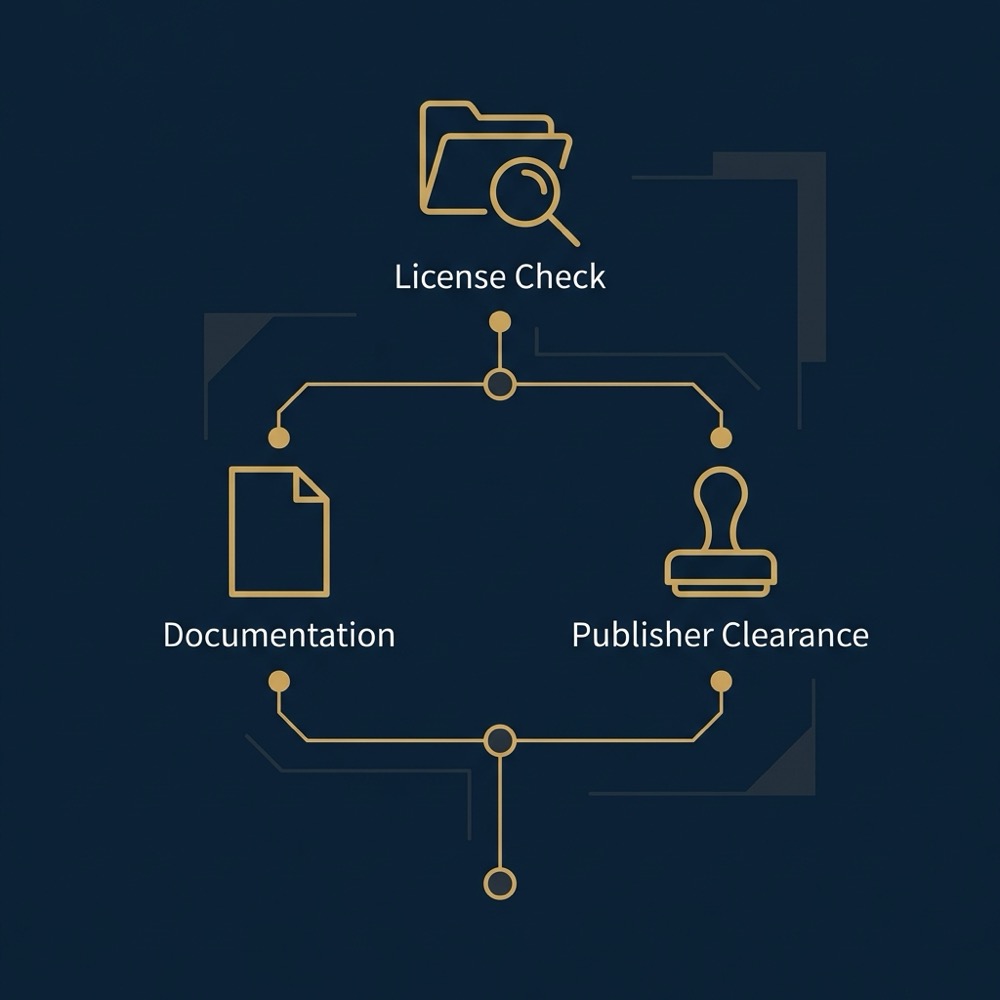
One practical step Orvus Limited often recommends to clients is a short diagnostic that maps licence risk, publisher requirements, and the evidentiary trail; this diagnostic helps determine whether to proceed, rework, or seek counsel.
Under current guidance in jurisdictions like the United States, pure machine generated works without meaningful human authorship are not registrable; registration is available where demonstrable human selection, arrangement or editing is present.
Many publishers now expect disclosure; it is advisable to disclose AI assistance early and provide documentation of human edits and prompt logs if requested.
Confirm the exact model terms and version date, check for commercial use permissions and training data clauses, and record the licence snapshot as part of your audit trail.
If you maintain good records and align licence permissions with publisher expectations, you reduce legal friction and make it easier to publish responsibly across jurisdictions.
References
Want this kind of work done for your business?
We build and run AI-powered marketing and automation. 15 minutes, honest assessment.
Book a call