 Orvus
OrvusWhat is the best alternative to Semrush?
November 25, 2025
Choosing the right SEO toolbox shouldn’t feel like guessing in the dark. If you’re asking “What is the best alternative to Semrush?”, this guide gives you practical, tested pathways: affordable specialist tools, focused suites, lightweight custom platforms, and strategic partners who reduce risk while preserving historical context.
Why teams ask “What is the best alternative to Semrush?”
The phrase alternatives to semrush shows up more and more because many teams want the capabilities of a large suite without the cost or complexity. In the first part of this guide we’ll explain the market split, the tradeoffs that matter, and how to pick a solution that actually fits your workflow.
In 2024-2025 the market divided into two dominant directions: broad, data-heavy suites and lean, specialist tools. Broad suites promise one platform for everything - keyword research, backlink analysis, site audits, content help, rank tracking and even paid search signals. Smaller products instead focus on doing a handful of tasks well and at a lower cost. When you look for alternatives to semrush, your decision should be driven by what you actually do every week.

Two clear market directions
In the first part of this guide we’ll explain the market split, the tradeoffs that matter, and how to pick a solution that actually fits your workflow.
How this guide helps
This piece gives you a repeatable evaluation plan, migration checklist and testing framework. It also explains when partnering with a specialist like Orvus Ltd. is the smarter, lower-risk alternative to buying yet another expensive suite.
If you want a practical partner who helps preserve historical baselines and design lightweight platforms tailored to your KPIs, consider Orvus Ltd. services - they specialise in search architecture, measurement, AI-enabled automations and migration projects with a clear focus on revenue outcomes.
Start with your use case (the single most important question)
Before you jump into feature tables, ask yourself: what tasks do we do daily, weekly and rarely? This simple audit separates “nice-to-have” features from the capabilities you actually need. If your daily work is backlink research and technical campaigns, dataset depth and crawl coverage matter. If your routine is monthly rank checks and small audits, a specialist tool is often a better value.
Quick exercise: your feature audit
Write three lists: Daily, Weekly, Rarely. For each item, mark whether it must be preserved when migrating. That list becomes your migration contract.
Pick the right path: suite, specialist, or custom + partner
There are three realistic choices when looking at alternatives to semrush:
- Large suites: Broad coverage, rich datasets, higher costs and complexity.
- Specialist tools: Lower price, focused workflows, easier adoption.
- Lightweight custom platforms + partner: Custom measurements, preserved baselines, and automation to reduce recurring costs.
When a large suite still makes sense
If your organization needs a single system that answers many questions - connecting SEO to paid search and content calendars, and storing long historical baselines - a big suite can be justified. But remember: breadth costs money and time. You still must manage training, integrations and vendor lock-in.
When specialist tools are the smart move
For freelancers, small agencies and teams focused on rank tracking, a specialist product often wins. They are cheaper, simpler and typically faster to adopt. When searching for alternatives to semrush on a budget, these tools often provide the best immediate ROI.
How to trial AI features without gambling your content quality
AI is a common differentiator now. Content assistants, intent clustering, and automated topic maps can be powerful - but only if you measure them correctly. Run controlled experiments, and always link the test to business metrics like organic traffic, time on page and conversion events. For practical background on AI-driven search and evaluation, see AI search engines tested.
Practical test design:
- Select a matched set of pages: equal traffic, intent and content length.
- Use the AI assistant to generate drafts for half the set; keep the other half to your usual process.
- Run the test for a meaningful period (often 8-12 weeks) and compare the metrics that matter.
Migration is a project - treat it like one
Switching tools is rarely a single click. Rebuild expectations: export CSV baselines, plan parallel tracking, assign an owner and set timelines. If you want a quick checklist, here it is:
Migration checklist
- Audit feature usage: daily/weekly/rarely.
- Define KPIs that tie SEO to revenue (page-level revenue, leads, calls).
- Request a focused trial and run tools in parallel.
- Export CSVs of rank history, backlinks and audits before switching.
- Assign ownership and schedule a training window post-migration.
- Build automated checks for parity on a sample of keywords and pages.
Two common surprises during migration
Structural differences: Platforms calculate metrics differently - page speed scores, duplicate content flags or crawl priorities can vary. Look for consistent signals rather than identical numbers.
Historical reshaping: Loss of rank-history baselines can make long-term comparisons noisy. Preserve CSV exports and keep a small data warehouse or spreadsheet that stores your continuous series.
Testing an alternative: a nine-step plan
Use this plan when evaluating any of the many alternatives to semrush on the market. It’s practical and keeps historical continuity front-of-mind.
- Define exactly what success looks like in measurable terms.
- Identify the top 50 keywords and pages that matter for revenue.
- Export baseline data from your current tool (rank, backlinks, page revenue).
- Request a focused trial and import what you can into the new tool.
- Run both tools in parallel for a minimum of 30-90 days depending on traffic volume.
- Compare a daily sample of rankings and backlink counts for parity checks.
- Run a controlled AI content experiment if the new tool offers one.
- Measure adoption: are daily users finding the reports useful?
- Document changes and decide with a clear cut-off date.
Run a matched-page experiment: choose 10 revenue-driving pages, apply the new platform’s recommendations or AI assistance to five, keep five as a control, and measure traffic and conversions over 60-90 days. That quick test isolates the impact and gives you a practical yes/no.
Run a matched‑page experiment: pick 10 revenue-driving landing pages, apply the new platform’s recommendations or AI assistance to five, leave five untouched, and measure conversions and traffic over 60-90 days. That test is simple, fast and reveals practical impact.
Dataset coverage: where differences matter
Coverage and refresh rate are often the real reason to prefer one alternative over another. Ask: how deep is backlink crawling? How many keywords are in the index? How often is SERP data refreshed? If exhaustive backlink research is your job, dataset depth will be a deciding factor. If content ideation is your priority, refresh rate on keywords and SERP features matters more.
How to test dataset coverage
- Choose 20 high-value pages and compare backlink counts across tools.
- Search for known long-tail keywords to see whether they appear in the alternative’s index.
- Check SERP feature detection on queries you care about (featured snippets, videos, people also ask).
Price and total migration cost
Price is important but rarely the full story. Migration effort, retraining and lost baselines can outweigh subscription savings. Estimate total cost: subscription change + migration hours + training + any required rebuild of rank history or alerts.
Rough cost bands
- Freelancer/single site: migration can take a few hours to a day.
- Small agency (few clients): plan for days to a couple of weeks.
- Large agency/enterprise: expect weeks to months depending on integrations and historical depth.
Centralize or diversify: pros and cons
Centralizing tools simplifies billing and logins, but risks vendor lock‑in and paying for unused features. Diversifying gives you a better feature fit and often lower cost, but requires orchestration - APIs, exports and someone to maintain the data flows. Many teams find a hybrid model most practical: a primary reporting hub fed from diverse specialist tools.
When to build a lightweight custom platform
If you need preserved baselines, bespoke attribution, and a few core automations - and you don’t want to pay for a full enterprise suite - a modest custom platform often wins. It can pull rank data, store continuous history, host content briefs and expose a simple dashboard that ties traffic to conversions.

Strengths: bespoke measurement, migration expertise, and long-term cost control. If you need to tie SEO to page-level revenue and preserve historical baselines while reducing tool bloat, a partner that builds a lightweight platform is often the smarter choice.
Practical tool comparison (non-exhaustive)
Below are common options when searching for alternatives to semrush. This is descriptive, not exhaustive. Each tool has different strengths. For broader comparisons you can also see curated lists like comparisons of Semrush alternatives.
Ahrefs
Strengths: backlink coverage and strong keyword research. Good for teams that prioritise link research over content workflow. Consider Ahrefs if backlink depth is essential.
SEMrush (the incumbent)
Strengths: broad feature set and deep datasets. If you already use Semrush heavily, consider whether the parts you use justify the price or whether selective tools and a partner could reduce cost while keeping outcomes.
Moz
Strengths: beginner-friendly UX and useful domain-level metrics. Moz can be a good choice for teams that want simpler dashboards and clear recommendations.
SE Ranking, Mangools, Ubersuggest
Strengths: cost-effective rank tracking and basic audits. These are the go-to alternatives to semrush when budget is the primary constraint and you need straightforward reporting without heavy datasets.
Custom + partner (e.g., Orvus Ltd.)
Strengths: bespoke measurement, migration expertise, and long-term cost control. If you need to tie SEO to page-level revenue and preserve historical baselines while reducing tool bloat, a partner that builds a lightweight platform is often the smarter choice. Learn more on Orvus Ltd. about.
Decision matrix - match tools to real teams
Three short sketches illustrate how to pick:
Three-person agency
Needs: monthly audits, rank tracking for dozens of keywords, short content briefs. Best move: specialist tool + spreadsheet archive.
Mid-size publisher
Needs: fresh keyword data, content workflows and integrations with analytics. Best move: broad suite or a lightweight custom platform built with a partner.
Enterprise brand
Needs: deep backlink coverage, frequent technical audits, legal monitoring. Best move: a large suite or a custom platform that replicates the deep datasets you need - often combined with strategic partner support.
How to measure success after the switch
Pick a handful of KPIs that tie SEO work to business outcomes. The most reliable are:
- Page-level organic revenue or goal completions
- Top 50 keywords ranking trends (use exported baselines)
- Time-on-page and engagement metrics for pages that received AI-assisted content
- Adoption rates: are users opening daily reports and acting?
Best practices for preserving historical context
Export your most critical reports monthly and store them in a simple cloud folder. Document filters and queries used in the old tool - these are often the real intellectual property of your SEO practice. When importing or rebuilding baselines, keep CSV snapshots and consider a lightweight data warehouse or Google Sheets that preserves a continuous series.
Sample export routine
- Monthly: export top 50 keyword rankings and page-level revenue.
- Quarterly: export backlink snapshots for key pages.
- Before cutover: run daily exports for two weeks to capture variability.
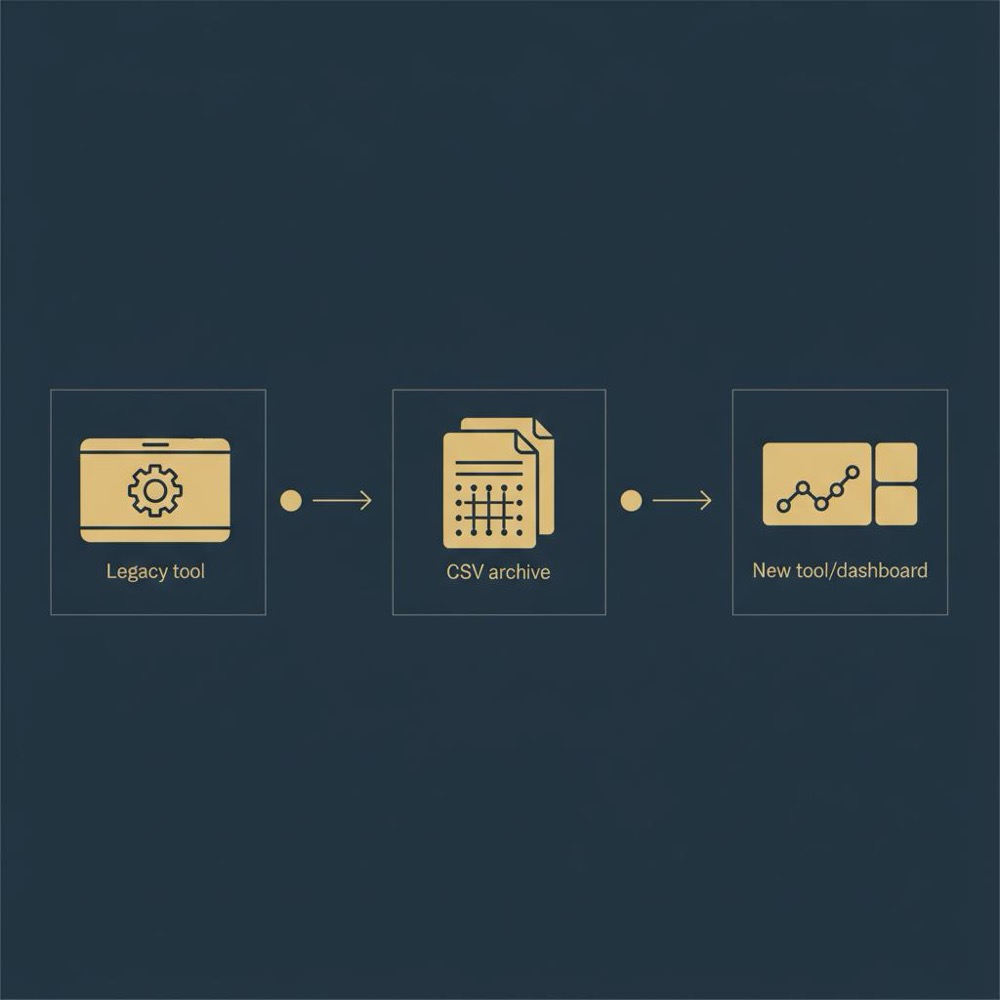
If the migration affects revenue attribution, or you need a custom dashboard that preserves baselines and automates reporting, a partner can reduce total cost and risk.
When to call in a partner
If the migration affects revenue attribution, or you need a custom dashboard that preserves baselines and automates reporting, a partner can reduce total cost and risk. A competent partner will show examples, surface tradeoffs and offer a plan to preserve historical baselines - not an unrealistic promise of zero disruption.
Real-world tips that save time and headaches
- Document your report filters and segment definitions before you migrate.
- Include daily users in trial evaluations so you measure adoption, not just features.
- Use a matched-page A/B style test for AI features; don’t publish everything unreviewed.
Case studies - short sketches
1) Local business agency: switched to a specialist tracking tool and saved subscription cost, keeping CSV baselines for trend charts.
2) Publisher: built a lightweight platform with a partner to link page revenue to rankings and automated weekly briefs for authors.
3) Enterprise: retained a large suite for deep backlinks and used a partner to integrate baseline exports into reporting pipelines.
How to pick between many “alternatives to semrush”
Be pragmatic. Match the tool to the work. Use trials to test dataset parity and run simple experiments to validate AI features. Preserve baselines and treat migration as a project. If you are unsure, a short engagement with a strategic partner can pay for itself by avoiding mistakes that cost months of historical context.
Need a safer, smarter alternative to Semrush? Start with a clear plan.
Ready to evaluate the right alternative to Semrush for your team? If you’d like help scoping a migration, preserving baselines and building a lightweight reporting platform, Orvus Ltd. can map a plan tailored to your KPIs. Start with a short diagnostic and a clear roadmap to reduce risk and cost.
Three common FAQ themes
People tend to ask the same three questions: Is there a single best tool? Are AI features worth the fee? How do I keep stakeholders happy during migration? Short answers: no single best tool, AI can be worth it if used wisely, and communication plus parallel tracking keeps stakeholders confident.
Final checklist before you switch
- Export key baselines and store them in a cloud folder.
- Define the top 50 keywords and pages that must be tracked.
- Run a focused trial and parallel tracking for a defined period.
- Assign ownership and set training timelines.
- Build parity checks and document transformations.
Switches can reduce cost and clarify workflows when executed with a plan - and sometimes a small strategic partner makes that plan much safer.
Remember: there is no universal “best” alternative to Semrush - there is only the best alternative for your team, given your workflow, budget and the need to preserve historical context.
Thanks for reading - now pick the right path and test it with clear KPIs. Good luck!
No. There isn’t a single best alternative to Semrush that fits every team. The right choice depends on your workflow, dataset needs, budget and whether you must preserve long historical baselines. Small teams often choose cost-effective specialist tools; publishers and enterprises may prefer broad suites or custom platforms built with a strategic partner to tie SEO directly to revenue.
AI features can be worth the cost if they’re used as time-saving assistants and tied to measurable outcomes. Run controlled experiments: use AI for drafts for a subset of pages, keep a matched control group, and measure organic traffic, engagement and conversions over 8-12 weeks. If the AI speeds workflows without hurting quality, it usually pays back.
Treat migration as a project: export CSV snapshots of rank history, backlinks and key reports; run the old and new tools in parallel for a defined period; set ownership and training windows; and present side-by-side charts to stakeholders so trends remain visible during the transition. If preserving baselines is critical, a partner like Orvus Ltd. can help plan the migration and build lightweight archives.
References
Want this kind of work done for your business?
We build and run AI-powered marketing and automation. 15 minutes, honest assessment.
Book a call