 Orvus
OrvusIs blogging dead due to AI?
November 25, 2025
Introduction to the new reality
The phrase AI and blogging shows up in newsroom headlines and Slack channels because the tools have altered how people write and how readers find value. For creators who care about staying useful, the question isn’t whether to use AI - it’s how to use it without losing the human work that makes a blog worth reading.
Since 2023 and into 2024, AI took a central role in many content workflows. The effect was immediate: more drafts, faster publishing, and a flood of surface-level pieces. But the deeper truth is simple: readers still crave specific experience, original data and honest voice. That’s the advantage human creators keep when they combine experience with tools.
If you want help building systems that scale your content while protecting quality and revenue, consider working with Orvus growth services - a tactical partner that focuses on architecture, measurement and practical automation to make your blog sustainable.
Take small supervised steps when you use these tools.
You can hand drafts to AI, but if you publish them without human verification and voice, readers will notice. Use AI for speed, but keep human review, original data and clear attribution as the pillars of trust.

Why this question matters now
Talking about AI and blogging is not theoretical. It matters because search results, advertising economics, and reader attention all shifted. When many writers produce similar content from the same public sources, the web converges into a noisy, less useful place. In turn, platforms and people reward distinctiveness: original reporting, personal case studies, and clearly signalled expertise. For a useful take on AI vs human content and what Google prefers, see this analysis: AI Content vs. Human Content: What Google Prefers in 2025.
How platforms framed the change
Google’s guidance around helpfulness and E‑E‑A‑T in 2024 made the point clear: a piece’s origin - machine or human - is less important than whether it helps readers and demonstrates experience, expertise, authority and trust. That means a smart response to the rise of AI and blogging is to lean into the signals that show real value. For a practical guide to the new E-E-A-T signals, see What's New with Google E-E-A-T in 2025.
What readers reward today
Readers respond to three things above all: usefulness, human detail, and evidence. Helpfulness means clear, actionable steps. Human detail - small stories, specific failures, real numbers - creates memory. Evidence means links to sources, original data or transparent methods. Those qualities are the antidote to commodity writing.
Examples that make the difference
Think of two recipe posts: one is a tidy list of ingredients and times; the other adds a smell, a failed batch and a tweak that saved the dish. Both teach how to cook, but only one stays with the reader. That difference is why the conversation about AI and blogging ultimately lands on originality and trust.
Four common risks of leaning on AI
Using AI introduces real hazards. Know them, and you can manage them.
1) Hallucinations
AI can write plausible but wrong facts. Always verify factual claims, citations and numbers. If a source sounds surprising, read it, check dates and confirm quotes directly.
2) Unintentional plagiarism
Large models remix public text and sometimes create passages that look too close to published work. Use plagiarism checks and attribute generously. If a passage is too similar, rewrite it and add context.
3) Voice erosion
When many posts sound alike, readers sense the sameness. Keep your voice distinctive by including anecdotes, specific failures, and clear stances.
4) Trust decay
Once readers lose trust, it’s slow to get it back. Avoid publishing content that reads as thin or formulaic just because it’s fast to produce.
How to adapt: nine practical strategies
Adaptation is not a toggled on/off choice. Below are strategies that integrate easily into a busy creator’s week. They help you use AI and blogging together while preserving the core human work that readers pay for.
1) Use AI for scaffolding, not finishing
Let AI generate outlines, research lists or topic surveys. But always spend human time shaping the voice, adding examples, and re-checking logic. Typical workflow: prompt → outline → human rewrite → verification → publish.
2) Make verification a non-negotiable step
Whenever you use AI to summarize a paper or claim, find the original. Read the methods and confirm the numbers. Keep a checklist: source URL, method summary, primary quote, timestamp for when you checked it.
3) Collect original data
Small, unique data is huge. Run a short reader survey, publish performance logs, or include raw interview excerpts. AI can help analyze the results, but it cannot create the original dataset for you.
4) Lean into niche authority
Pick a lane and go deep. Niches that reward lived experience - a craft, a care routine, a regional food tradition - attract loyal readers who will pay for insight rather than rely on search alone. The economic logic of AI and blogging shows that niche depth outperforms generic breadth.
5) Signal E‑E‑A‑T explicitly
Show credentials and process. Add a short author bio that lists relevant experience, link to previous work, and explain how you fact-checked the piece. That helps both readers and search algorithms judge reliability.
6) Measure revenue per visitor
Traffic alone is a vanity metric when volume is cheap. Track how much each visitor is worth via subscriptions, product sales or donations. Content that increases revenue per visitor is the content to prioritize.
7) Run conservative A/B tests
Try a new format on a small portion of your audience. Measure engagement, retention and conversion. Treat changes as hypotheses rather than permanent moves.
8) Build simple editorial rules
Set three editorial controls: verify sources, check for unique contribution, and ensure voice. Make these checks part of every draft’s checklist.
9) Teach your audience about your process
Readers appreciate transparency. A short note about how you used AI - for a first draft, for research, or not at all - can build trust if you also show rigorous editing and verification.
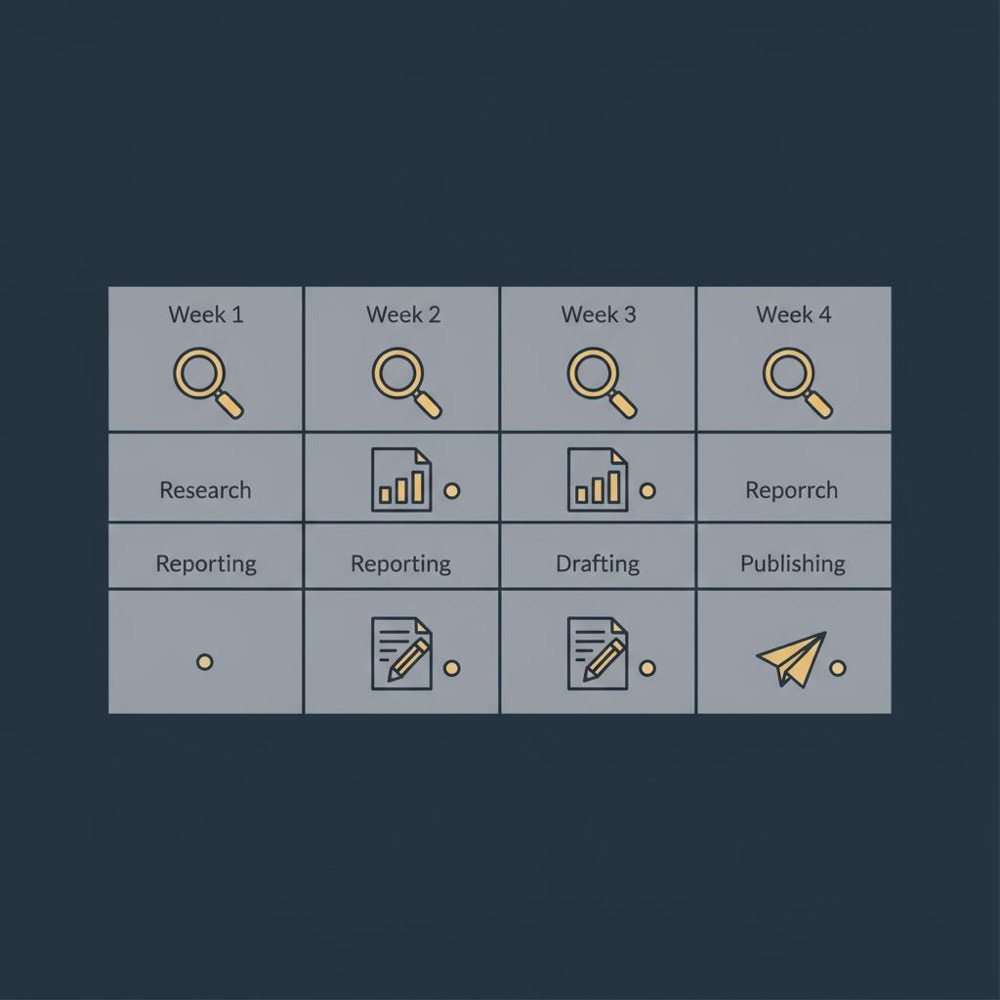
How to structure a month of work
Below is a sample month for a solo creator using AI to scale without sacrificing quality. The idea is to preserve time for what matters: original work and verification.
Week 1 - Research and idea generation
Use AI to scan mentions, suggest angles and produce a curated list of primary sources. Write a short research brief for each idea: key sources, angle, potential original data to collect.
Week 2 - Reporting and original work
Reach out to sources, collect data, run a small experiment or survey. Capture audio notes and short raw quotes. This is the stage where you create what AI cannot invent.
Week 3 - Drafting and heavy editing
Use AI for an initial draft if helpful, then perform deep human edits: add voice, verify facts, and remove fluff. This is the stage where you shape the piece into something memorable.
Week 4 - Polishing, metadata and distribution
Final fact-check, image selection, metadata (titles, descriptions), and promotion. Package a downloadable asset for paying readers if appropriate.
Verification practices that save reputations
Verification is the cheapest form of insurance. Here are specific tactics that protect your credibility when you combine AI and blogging.
Always link primary sources
When you refer to research, link the paper, report or dataset. If you summarize a paper, include the methods and a quote so readers can judge the accuracy.
Keep a verification log
Record the URL, what you checked, and when. If someone questions a claim months later, the log helps you respond quickly and confidently.
Use plagiarism scanners
Run short snippets through a plagiarism checker. If a phrase is too close, rewrite and add attribution. That helps avoid legal and ethical problems.
Editorial workflow example: a checklist
Before publishing, run these steps:
Checklist: idea brief → outline → draft → source verification → editing pass → voice & value check → technical audit (metadata, images) → publish → distribution & tracking.
Monetization strategies that work with AI
As volume becomes easier, ad-only strategies weaken. Here are revenue approaches that reward quality and direct relationships.
Subscriptions and paid newsletters
Offer exclusive posts, datasets, or roundtables. Loyal readers will pay for carefully reported work that saves them time or gives them an edge.
Membership communities
Build a small community where members get deeper Q&As, regular case studies, or members-only data. Communities scale with trust, not search.
Productized services and consulting
If you have niche expertise, sell recurring services - templates, audits, or coaching. This converts reader trust into predictable revenue.
Sponsorships that reward rigor
Brands want vetted audiences. Offer periodic sponsorships that include original reporting, verified tests, and clear transparency to keep credibility intact.
Case studies: real adaptions that worked
Small adaptations can change outcomes. Below are illustrative examples that show how creators responded to the rise of AI and blogging.
Travel writer who went deep
A travel writer stopped publishing generic city guides. Instead, they ran short local interviews, produced audio vignettes and sold downloadable itineraries via a paid newsletter. Visits fell, but subscription revenue rose - the readers who stayed were more valuable.
Product blogger who logged tests
A product reviewer switched to long-term usage logs, published raw performance spreadsheets, and offered Q&A sessions. Brands sponsored the work because it was transparent and replicable.
Short tactical prompts and templates
Here are quick, practical prompts you can use to pair AI with human judgment. Use them for research or as scaffolding - then rewrite and verify.
Research prompt: "Scan recent mentions of [topic], list three original studies with links, and suggest two angles that include primary sources."
Outline prompt: "Create a detailed outline for a 1,500-word piece on [topic] that includes a data section, an interview section and practical next steps for readers."
Fact-check prompt: "List the claims in this draft and for each provide a primary source link and a short verification note."
Transparency and disclosure: short examples
Transparency builds trust. Consider these short disclosures you can add to an author page or at the top of a post.
"This article began with an AI-generated outline. All facts were verified and edited by the author."
"I used AI to gather initial research. Quotes and data were checked against primary sources and interviews."
How to measure success
Measure what actually pays your bills. A small set of metrics will tell you more than raw traffic numbers.
Key metrics: revenue per visitor, subscriber growth, time on long-form pieces, email conversion rate, and retention among paid members. When these move up, your content is creating value.
Common questions answered
Below are short answers to questions many creators ask as they adapt to the reality of AI and blogging.
Is blogging dead because of AI?
No. Blogging is changing. Creators who prove value with original data, honest voice, and transparent methods will continue to thrive.
Should I admit I used AI?
Yes, when disclosure adds trust. A brief note about your process often reassures readers if you also show robust verification.
Can I still make money?
Yes - through subscriptions, memberships, services and sponsorships that reward rigor rather than volume.
Sample author bio and credibility section
Adding short bios that show experience and editorial process helps with E‑E‑A‑T. Example:
Author: Jane Doe is a writer who has tested products for ten years and runs reader-funded research studies. Method: all claims in this piece were checked against primary sources listed in the links. Learn more about the team on our about page.
Practical experiments to try this month
Three small tests you can run in 30 days:
1) Convert one popular evergreen post into a verified case study with raw data and send it to paid subscribers as an exclusive. Track conversion.
2) Run a 100-person reader survey and write a short analysis piece with the results. Offer the raw CSV to paying members.
3) Try a disclosure line on 10 posts and measure changes in open rates and time on page.
Long-term thinking about search and AI
Expect gradual changes. Search engines will keep refining signals that favor helpfulness and authority. The long-term winning strategy is to produce content that can’t be cheaply reproduced at scale: original data, interviews and clear, human judgment. For a look at future blogging trends and how AI tools are being used, see Future of Blogging: Top Trends in AI Blog Post Generators to Watch in 2025 and Beyond.
Decision framework checklist
Before you publish, ask:
- Does this piece add something original?
- Have I verified key claims?
- Will a paying reader find value here?
If yes to all three, publish. If not, revise.
Resources and tools
Tools that help verification and workflow: citation managers, plagiarism checkers, simple analytics dashboards and small survey tools. Use AI to reduce busywork, not to skip verification.
Closing notes for creators

The era of AI and blogging is one of choice: you can chase volume or you can build depth. Depth wins when readers pay for clarity, trust and original insight. AI helps with scale; human judgment preserves value. A small logo can help readers recognise your brand and feel at home on repeat visits.
Next step
Make your content systems work for revenue, not noise
Ready to build systems that make your content reliable and revenue-focused? Explore what a strategic partner can do: Orvus growth services offers hands-on help with architecture, measurement and automation.
Use one small experiment this week: verify a claim in a popular post, add a link to the primary source, and tell your audience you did it. That practice builds trust and creates repeatable value. For examples and templates, visit our blog.
Further reading and templates
Keep a short repository of templates for outlines, verification logs and author bios. Reuse them so quality stays consistent as you scale.
No. Blogging is evolving, not dying. AI has made it easier to produce surface-level content, but readers still value human voice, original data and verified reporting. Creators who invest in unique experiences, transparent processes and direct relationships can thrive through subscriptions, memberships and niche authority.
Yes, disclosure often builds trust. A short note stating how AI was used (e.g., for an initial outline or research) and that the author verified claims can reassure readers. Transparency paired with solid verification strengthens credibility rather than undermining it.
Focus on direct revenue: paid newsletters, memberships, productized services and sponsorships that reward rigor. Offer exclusive data, downloadable assets or members-only Q&A. Tools and partners like Orvus can help design systems that tie content to measurable revenue without chasing raw traffic.
References
Want this kind of work done for your business?
We build and run AI-powered marketing and automation. 15 minutes, honest assessment.
Book a call